

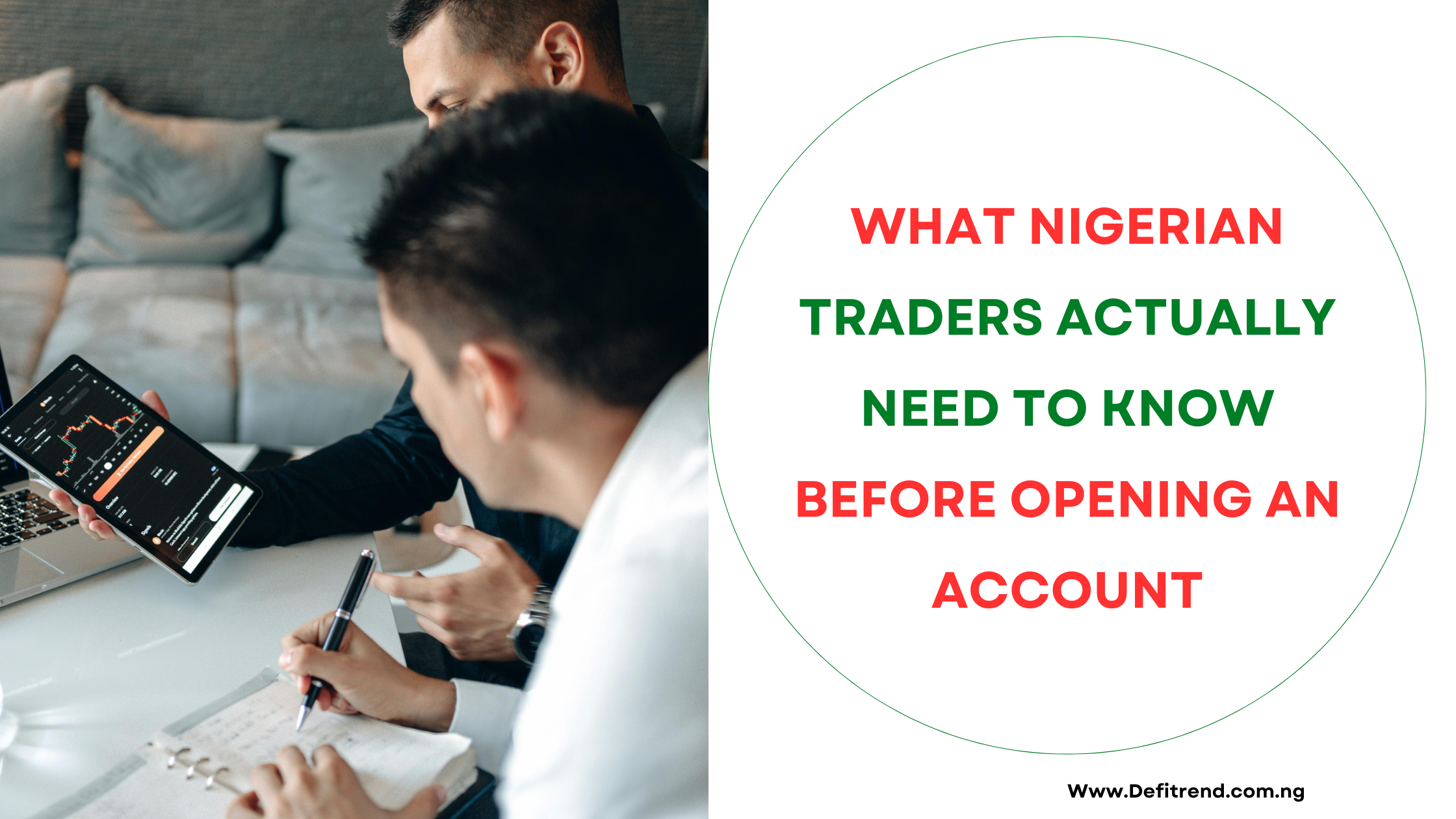
Three Nigerian traders I spoke to this month lost money not from bad trades — but from choosing the wrong broker. Wrong spread structure. Hidden withdrawal fees. Platforms that froze during NFP volatility. In 2026, the broker choice is the trade.
Since 2024, first-time retail Forex participation has surged across West Africa, driven by cheap smartphones, social media funnels, and a naira that has pushed millions of Nigerians to seek dollar-denominated alternatives to savings accounts. The African forex market is now projected to see retail trader numbers grow 30% year-on-year, largely fuelled by mobile penetration and rising interest from Nigeria and Kenya. Global Forex turnover already hit an estimated $9.6 trillion daily in April 2025 — and Africa is increasingly showing up in that number.
Here’s the uncomfortable truth: a bad broker will cost you more than a bad strategy. Spreads, withdrawal delays, and unregulated offshore entities are often where beginner capital goes to die. This guide exists to change that.
Why Broker Selection Has Never Been More Critical for Beginners
The global Forex broker landscape in 2026 has undergone significant consolidation. Tier-1 regulators — the FCA (UK), ASIC (Australia), and CySEC (Cyprus) — have tightened their frameworks around leverage caps, negative balance protection, and segregated client funds. This is broadly good for traders. The problem is that the most heavily marketed brokers targeting Nigerian beginners are often not operating under these Tier-1 umbrellas. They present polished Instagram pages and affiliate-linked “funded account” offers, while being registered in jurisdictions like St. Vincent & the Grenadines or Vanuatu — places with minimal investor protection infrastructure.
How to Start Forex Trading for Beginners: A Step-by-Step Guide (No Experience Needed)
At the same time, Nigeria’s regulatory environment is evolving. The CBN launched its Nigeria FX Code in January 2025 — a comprehensive framework aligned with global standards, designed to improve conduct, transparency, and market integrity in FX activity. Nigeria’s Securities and Exchange Commission (SEC) has publicly warned that online retail Forex trading is vulnerable to abuse when conducted through unregulated channels, and it now provides tools for traders to verify broker registrations before depositing. In 2026, regulatory compliance is no longer optional — it’s the filter you should apply to every broker you consider.
The marketing explosion around beginner-facing brokers has made the landscape more dangerous, not less. When a broker spends heavily on Instagram ads and TikTok influencers rather than on platform infrastructure and regulatory compliance, that budget has to come from somewhere. More often than not, it comes from the spread.
What Separates a Beginner-Friendly Broker from a Beginner-Targeting One
The Criteria That Actually Matter in 2026
Regulation Tier — Non-Negotiable
Tier-1 regulators (FCA, ASIC, CySEC) enforce the rules that actually protect your money: segregated client accounts, negative balance protection, mandatory capital adequacy, and participation in investor compensation schemes. FCA-regulated brokers, for example, must keep client funds completely separate from their operational accounts — meaning if the broker goes insolvent, your money is not part of the bankruptcy estate. Retail traders under UK/EU-linked regulation also benefit from leverage caps of 1:30 on major pairs, which limits the speed at which a beginner can blow an account.
A broker registered solely with an offshore regulator is not offering you equivalent protection — regardless of how professional their website looks.
Spread Type: Fixed vs. Variable
For beginners trading news events like NFP, FOMC, or CPI releases, the spread structure is everything. Variable spreads on many offshore “no commission” brokers will widen to 3.0, 4.0, or even 8.0 pips during high-impact releases — meaning your trade is already significantly offside the moment it opens. Some of the most reputable brokers in 2026 offer EUR/USD spreads averaging around 1.00 pip on standard accounts and as low as 0.17 pips on ECN/Razor-type accounts. That difference is not cosmetic — it is real money.
Minimum Deposit Reality in NGN Terms
A “$10 minimum deposit” sounds accessible. At the current parallel rate of approximately ₦1,300–₦1,380 to the dollar (as of mid-2026), that’s roughly ₦13,800 — not negligible for a first-time trader. A “$100 minimum” — common among more professional brokers like FP Markets or FxPro — becomes ₦130,000+. Understanding the NGN equivalent of your broker’s deposit requirements is not just a maths exercise. It should inform your risk management from day one.
Platform Simplicity
MT4 remains the most widely supported platform globally and has the lowest learning curve for most beginners — vast community resources, YouTube tutorials, and template strategies are built on it. MT5 adds more timeframes and assets, which matters if you plan to trade beyond Forex into indices and commodities. Proprietary platforms (like AvaTrade’s AvaTradeGO or XTB’s xStation 5) are often cleaner for pure beginners but lock you into a single ecosystem.
NGN Withdrawal Options
This is where many brokers that are fine for European clients become painful for Nigerian ones. Verify before depositing that your broker supports: local bank transfers in Nigeria, USDT (Tether) withdrawal as an alternative route, or e-wallet options like Skrill or Neteller that you can off-ramp through a local P2P exchange. Withdrawal timelines matter too — some brokers process within 24 hours; others take 5–10 business days, which effectively traps your liquidity during volatile market periods.
What Is Leverage in Forex Trading? (Simple Explanation for Beginners)
Red Flags Beginners in Nigeria Miss
- “No commission” brokers with 3.0+ pip spreads on EUR/USD. The commission doesn’t disappear — it hides in the spread. A 3.0 pip spread is one of the most expensive ways to enter a trade.
- Registration in St. Vincent & the Grenadines or Vanuatu only. These jurisdictions have minimal enforcement power. If a dispute arises, your recourse is effectively zero.
- No negative balance protection. Without this, a fast-moving market during a news event can leave you owing the broker money beyond your deposit.
- 5–10 business day withdrawals. This is not just inconvenient — during volatile periods, it means you cannot access capital when you may need it most.
- Brokers that steer you to their offshore entity. Many multi-regulated brokers have both a Tier-1 entity and an offshore entity. Some actively route Nigerian clients to the offshore entity to avoid stricter rules. Always confirm which entity you’re registered under at the point of onboarding.
The 2026 Regulatory Shift You Should Know
ESMA, FCA, and ASIC leverage restrictions mean that Nigerian retail clients accessing brokers through their Tier-1 entities are capped at 1:30 on major pairs. This is not a punishment — it is a structural protection. If you are accessing leverage of 1:500 or 1:1000 through an offshore entity, understand that the regulatory safety net under that arrangement is significantly thinner.
The Best Forex Brokers for Beginners in 2026 — Defitrend’s Picks
The following three picks are based on publicly available, independently verified data from ForexBrokers (2026 Annual Awards), FXEmpire, DayTrading, and DailyForex — cross-referenced against regulatory status, spread benchmarks, and platform access.
🥇 Top Pick: AvaTrade — Best Overall for Nigerian Beginners
Regulation: Central Bank of Ireland, ASIC, FSCA (South Africa), ADGM (UAE), FSA (Japan) — genuinely multi-regulated with African representation via FSCA.
Why it tops the list: AvaTrade earned Best in Class honours for Education, Beginners, and Copy Trading in the ForexBrokers 2026 Annual Awards — not based on marketing, but on independently audited data. The AvaAcademy offers over 100 structured courses organised by experience level, with video and written content, progress tracking, and integrated quizzes. For a Nigerian beginner building their knowledge alongside their account, this is the most complete learning environment of any broker on this list.
Spreads: EUR/USD typically 0.9–1.3 pips on the standard account. Commission-free across most pairs. No commissions means cost transparency — you always know what the trade costs before you enter.
Platform: MT4, MT5, and the proprietary AvaTradeGO mobile app — clean, well-optimised, and built with beginners in mind. The Guardian Angel risk management plugin for MT4 adds an extra layer of protection. AvaProtect allows traders to partially hedge open positions, a feature with real practical value during high-impact news.
Copy trading: AvaTrade supports ZuluTrade, DupliTrade, and AvaSocial — three copy-trading platforms that let beginners mirror experienced traders while developing their own skills.
Withdrawal: Typically 1–2 business days via bank wire, e-wallets (Skrill, Neteller), and card.
Watch out for: Inactivity fee of $100 after 12 months of non-use. If you are trading intermittently, factor this in.
🥈 Runner-Up: XM Group — Best for Pure Beginners / Lowest Barrier
Regulation: CySEC, ASIC, DFSA (Dubai), FSC (Belize/Mauritius).
Why it earns its place: XM accepts clients from Nigeria and offers a $5 minimum deposit — making it the most accessible regulated broker on this list in NGN terms (approximately ₦6,900 at current rates – May 2026). For a first-time trader who wants to open a live account with real money, experience real psychology, and learn without catastrophic downside exposure, this is the lowest-friction entry point among reputable brokers.
Education: Free webinars available in 19 languages, covering market basics through to intermediate strategy. The volume and frequency of educational content is above industry average for a broker at this price tier.
Spreads: Variable, from around 1.0 pip on major pairs under the CySEC entity. During quiet sessions, competitive. During news events, widen more aggressively than Tier-1-only brokers.
Platform: MT4 and MT5 both supported — clean, widely documented, huge community of tutorials.
Note: XM does not accept clients from the United States. For Nigerian traders, the CySEC-regulated entity is the relevant one — confirm this at registration.
🥉 Best for Beginners Who Want to Scale: Pepperstone
Regulation: FCA (UK), ASIC (Australia), CySEC, BaFin (Germany), DFSA, CMA (Kenya), SCA.
Why it rounds out the list: Pepperstone was rated best in class for Trading Fees, Copy Trading, Algo Trading, TradingView, and MetaTrader by ForexBrokers in its 2026 Annual Awards. It is not a pure beginner broker — but it is the correct next step for a trader who has completed their demo period and wants professional-grade execution.
Spreads: Standard Account averages 1.00 pip on EUR/USD, zero commission. Razor Account delivers raw spreads averaging 0.17 pips on EUR/USD with a $6–$7 round-lot commission — appropriate for higher-frequency trading as your volume grows.
Minimum deposit: No fixed minimum — approximately $14 as a practical threshold in most jurisdictions.
Platforms: MT4, MT5, TradingView, and cTrader — the widest platform selection of any broker on this list. cTrader in particular is praised for its clean design, which is accessible to beginners while offering the advanced order types and automation options experienced traders need.
Withdrawals: Same-day processing for verified traders. Apple Pay and Google Pay now live as of 2025. This is the fastest withdrawal pipeline of the three picks listed here.
Watch out for: Limited internal research content. Pepperstone partners with Autochartist to fill this gap, but independent market analysis is not a core strength. If research and news integration matter to you, AvaTrade serves that need better.
What Forex Brokers Won’t Tell Nigerian Beginners (But Should)
The NGN/USD parallel rate problem. Funding a broker account at the wrong exchange rate can eat into your trading capital before you place a single trade. At a parallel rate significantly weaker than the interbank rate, the real cost of your deposit — and your risk per trade — is higher than the broker’s USD figures suggest. Always calculate your position sizing and risk in NGN equivalent, not just in dollar terms.
The CBN’s evolving FX framework. Nigeria’s central bank has actively tightened the formal FX market throughout 2025 and into 2026 — pushing more activity into regulated, transparent channels. The CBN now allows licensed Bureau de Change operators to access up to $150,000 per week from authorised dealer banks, with tighter controls including KYC requirements and electronic reporting. This formalisation is positive for serious traders, but it also means the informal P2P funding routes carry increasing compliance risk.
Forex Trading Basics Explained: A Simple Guide for Beginners
FSCA (South Africa) as a middle ground. For African traders who want regional regulatory accountability, brokers with active FSCA registration — such as AvaTrade, Pepperstone (via CMA Kenya), and FxPro — offer a meaningful alternative to purely offshore structures. FSCA has intensified oversight since 2025, requiring stricter AML compliance and clearer risk disclosures. Choosing a broker with FSCA or CMA regulation alongside a Tier-1 licence gives you both global protection and African regulatory recourse.
The “funded account” affiliate trap. Nigerian beginners are disproportionately targeted by social media campaigns that combine broker affiliate programs with “funded account” offers. The model typically involves paying a challenge fee, trading to a profit target, and receiving a “funded account” from a prop firm partner. Many of these are run through unregulated entities with opaque payout terms. Research any such offer through the SEC Nigeria investor alert list and the FCA register before committing capital.
P2P funding routes. With CBN restrictions on domiciliary account FX remittances, many Nigerian traders fund broker accounts via USDT purchased on P2P platforms or through services like Africhange. This introduces counterparty risk at the funding stage that is entirely separate from broker risk. Use established, high-volume P2P providers with verifiable track records, and keep records of all transactions.
My Take Heading Into the Rest of 2026
The best broker for a Nigerian beginner in 2026 is not the one with the flashiest Instagram ads — it is the one that lets you withdraw in 24 hours, doesn’t requote you during high-impact news, holds your funds in a segregated account under a Tier-1 regulator, and provides you with a structured path from zero knowledge to consistent practice.
AvaTrade covers that brief most comprehensively, with FSCA regulation adding African accountability to its Tier-1 global structure, and the AvaAcademy providing the most organised educational environment of any mainstream broker.
As the CBN continues to formalise Nigeria’s FX market and tighten the informal funding rails, brokers with USDT withdrawal options and multi-currency e-wallet support will become the default for Nigerian retail traders by Q4 2026. Platforms that can’t adapt to that funding reality will lose Nigerian clients to those that can.
One final rule: Demo trade for a minimum of 30 days before committing real capital. Not because it guarantees profitability — it does not — but because 30 days of demo trading on your chosen broker’s actual platform will reveal execution quirks, spread behaviour during news events, and platform stability in ways that no review article can simulate.
Always verify a broker’s licence directly on the FCA register (register.fca.org.uk), the FSCA register (fsca.co.za), or the ASIC register (asic.gov.au) before depositing. Any broker that cannot be found on at least one of these registers should be avoided.
Follow Defitrend for our weekly broker watchlist and Forex setups tailored for African traders. Drop your broker in the comments — we’ll tell you what we think of it.
Disclosure: This article is for informational purposes only and does not constitute financial advice. Forex trading carries significant risk of loss. Between 70% and 80% of retail investor accounts lose money when trading CFDs. Always trade with capital you can afford to lose.
Sources: ForexBrokers 2026 Annual Awards | FXEmpire Broker Reviews (March 2026) | DailyForex Pepperstone Review (February 2026) | BusinessDay NG / TechBuild Africa — Africa Forex Market Trends 2026 | Contentworks Africa Forex Outlook 2025 | CBN Nigeria FX Code, January 2025 | FXLeaders Nigeria Forex Reserves Report, May 2026 | GistReel CBN Liquidity Analysis, May 2026


Leave a Reply