

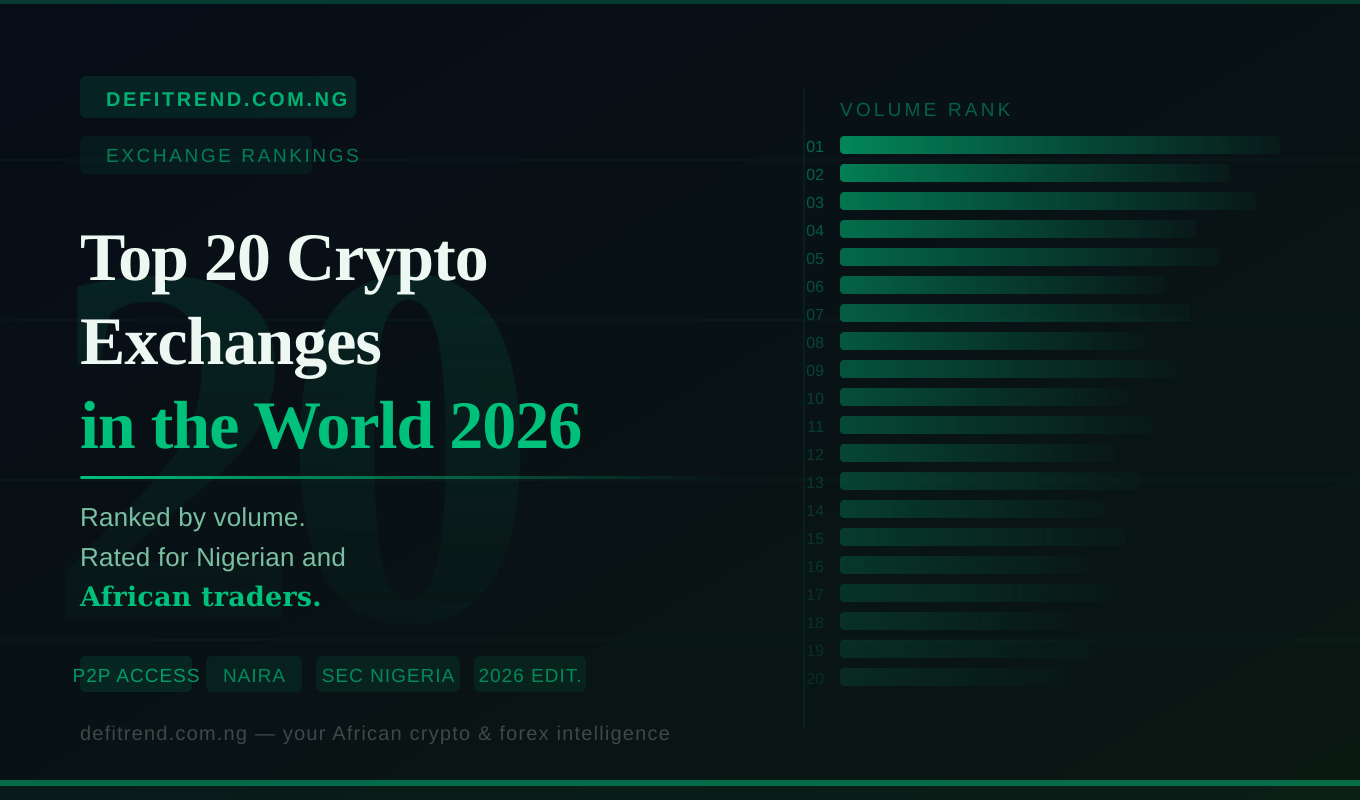
Most crypto traders know three exchange names. Maybe five. But the real liquidity story in 2026 is being written across 20 platforms — and what is happening in positions 6 through 20 is more interesting than anything in the top three right now.
Binance still towers over the whole field. That has not changed. But the nine exchanges sitting directly behind it are fighting each other for every fraction of a percent of market share — and the data from CoinGecko’s 2025 Annual Report tells a fascinating story. The top 10 exchanges combined processed $18.7 trillion in spot trading volume in 2025. And the gap between position 2 and position 10 is much smaller than most people think. According to CoinGecko, positions 2 through 10 are all clustered between roughly 5.5% and 8.1% market share. One bad quarter and you drop two spots. One great product and you jump three.
More importantly for Nigerian and African traders: the exchanges ranked 6 through 20 include some of the most accessible, lowest-friction platforms that most Nigerian traders have never seriously considered. The 2024 Binance-CBN standoff should have made every Nigerian trader curious about what else is out there. Most still haven’t looked.
This post covers all 20. Every entry gets a simple breakdown and a straight verdict — written from the ground up for traders in Lagos, not London.
How to Start Crypto Trading Step by Step 2026 (Beginner’s Guide)
Why the Full Top 20 List Matters More Than the Top 5 in 2026
The FTX collapse in November 2022 did one thing above everything else: it pushed volume to the top three exchanges almost overnight. Traders were scared and they went to the biggest names they knew. Binance went from under 50% to nearly 65% of global market share in a matter of weeks.
But by 2025 and 2026, that extreme concentration is slowly spreading back out. New exchanges have matured, improved their products, and won traders back. According to CoinGecko’s Spot CEX Report 2026, the top 12 exchanges alone processed nearly $21 trillion in spot volume in 2025. That is a market big enough for many platforms to eat well.
The regulatory story is splitting the field. US-regulated exchanges like Coinbase, Kraken, and Gemini are winning institutional flows — the big money from pension funds and hedge funds that needs a legal wrapper. Offshore exchanges like Bybit, Gate.io, and MEXC are winning retail traders and derivatives volume. Both strategies are working — just for different types of users.
DEX (decentralized exchange) volume also hit 21.7% of all global spot crypto trading in 2025, according to CoinGecko data. Platforms that blend CEX and DEX tools — like OKX — are eating from both sides. That trend is only going one direction.
For Nigeria specifically: the CBN-Binance standoff in 2024 forced traders here to diversify. The good news is that several exchanges in the 6–20 range — MEXC, Bitget, Gate.io, BingX — have better NGN P2P infrastructure than most Nigerian traders currently realize. The hard work of finding alternatives has already been done. You just have not opened the accounts yet.
Top 20 Crypto Exchanges in 2026 — Every Entry Ranked, Rated, and Reviewed
The rankings below use CoinGecko’s 2025 full-year spot market share data as the primary source, cross-referenced with CoinGlass 2025 derivatives data, CoinLaw exchange statistics, and independent exchange reviews from Breet, FXEmpire, and Coin Bureau. Market share percentages are 2025 full-year figures.
TIER 1 — The Untouchables (Positions 1–5)
These five run the market. Together, they account for the overwhelming majority of global crypto volume.
1. Binance | Market Share: 39.2%

Binance is so far ahead it almost does not belong in the same ranking. According to CoinGecko, Binance alone processed 39.2% of all top-10 spot trading volume in 2025 — more than positions 2 through 5 combined. User assets held on Binance represent approximately 73.5% of all major CEX reserves globally.
What it is best at: everything at scale. Deepest liquidity on every major pair. Widest altcoin selection. The most developed P2P infrastructure in the world — until it pulled NGN services in 2024.
Weakness: The 2024 CBN standoff removed NGN P2P from Nigerian users. The legal case with the Nigerian government was still in Abuja’s Federal High Court as of mid-2026. Domain access requires a VPN for most Nigerian internet providers.
Nigerian verdict: Still the most important exchange on earth for understanding where the market is going. But it should never be your only exchange again. The 2024 suspension made that permanent policy, not a temporary caution.
2. Bybit | Market Share: 8.1%

Bybit ended 2025 as the second-largest exchange by spot volume — a position it earned by being the best derivatives exchange in the world for retail traders, not by copying Binance. Its copy trading product is independently rated as the best in crypto. In February 2025, Bybit was hit with a $1.5 billion hack — the largest in crypto history. It replenished all reserves within 72 hours from its own balance sheet. No customer lost money.
What it is best at: derivatives, copy trading, and a cleaner mobile interface than any other top-5 platform.
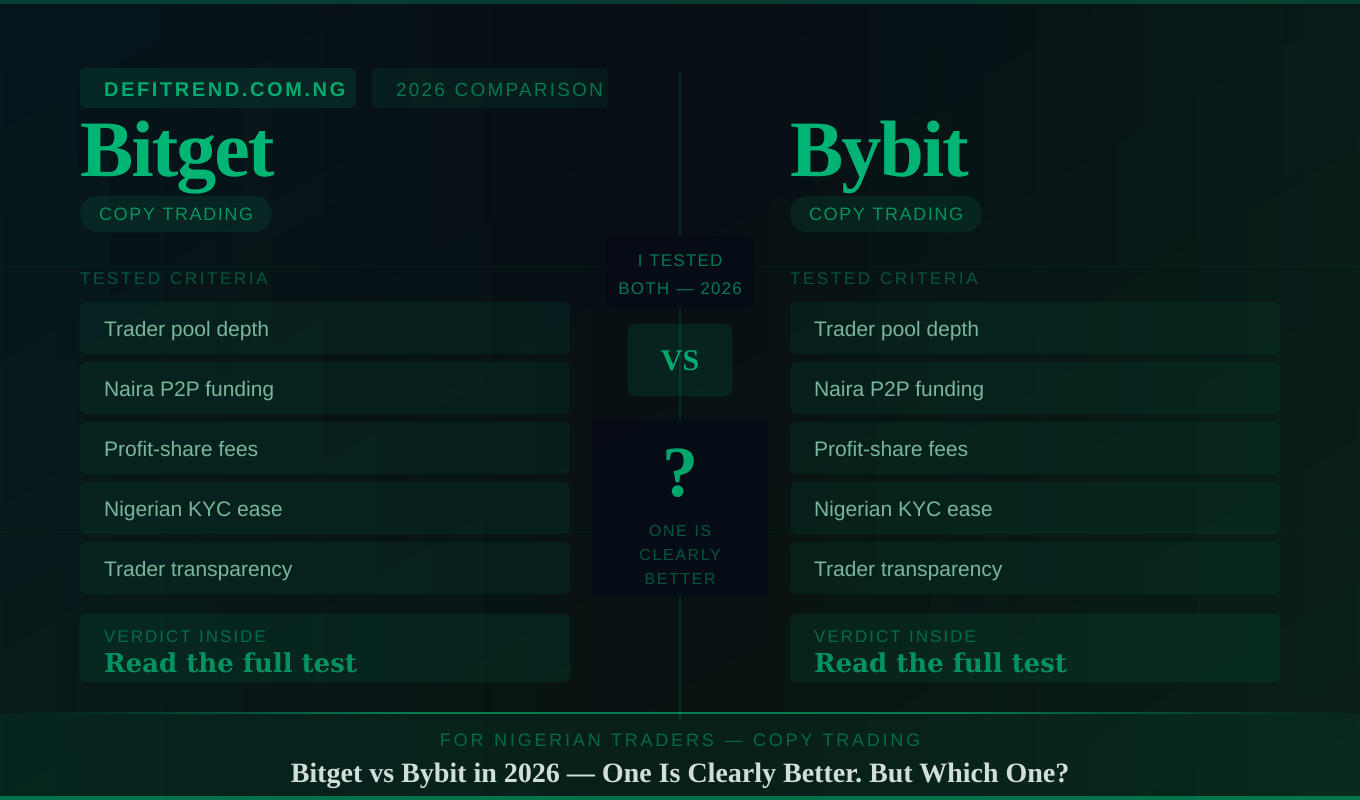
Nigerian verdict: Your primary derivatives and copy trading home. Also the most functional NGN P2P option currently available among globally-ranked exchanges. If you only open one new exchange account in 2026, this is it.
3. MEXC | Market Share: 7.8%
MEXC grew 90.9% year-on-year in 2025 — the fastest growth of any top-10 exchange. The driver is simple: zero maker fees. When you place a limit order on MEXC, you pay nothing. That is a real cost advantage for patient traders who plan their entries.
What it is best at: low fees, rapid new altcoin listings, and strong NGN P2P support. According to a 2026 MEXC P2P Nigeria review, MEXC P2P is the leading choice for Nigerian traders for its zero-fee P2P structure, support for over 300 NGN payment methods, and fast settlement.
Weakness: Reserves are thinner relative to volume than most top-tier peers. CoinGecko’s 2026 Spot CEX Report showed MEXC has an asset velocity ratio of 1.44–2.04, meaning traders are moving much larger volumes than MEXC holds in reserves. Not a reason to panic, but a reason to withdraw profits rather than leave them sitting.
Nigerian verdict: Open this account. The zero-fee P2P model and wide NGN payment support make MEXC one of the best on-ramps available to Nigerian traders right now.
4. Gate.io | Market Share: 7.5%

Gate.io has been operating since 2013, making it one of the oldest exchanges still in the top 5. It lists over 1,700 cryptocurrencies — more than almost any other exchange on this list. In Q1 2026, Gate ranked second in cumulative spot volume ($201.4 billion) according to CoinGlass data.
What it is best at: altcoin selection and long operating history. If a coin exists and trades somewhere, Gate.io probably lists it. It also holds regulatory licenses in Malta and Australia.
Nigerian access note: Nigerian users can access Gate.io via the mobile app, although the website itself is blocked. P2P trading and Express Buy features are available. Selling crypto requires converting to USDT first.
Nigerian verdict: A solid altcoin discovery exchange and a useful second or third P2P account. The website block is a friction point, but the mobile app works. Good for research even if you execute trades elsewhere.
5. Crypto.com | Market Share: 7.2%
Crypto.com is a strong consumer brand — you know it from sports sponsorships. The product behind the marketing is decent: a clean mobile app, crypto Visa card integration that lets you spend crypto at real stores, and basic spot trading.
What it is best at: the mobile app experience and spending crypto via the Visa card product.
Weakness: Crypto.com had the worst quarter-on-quarter drop of any top-10 exchange in Q2 2025, falling 61.4% in volume according to CoinGecko’s Q2 2025 report. It dropped from the #2 spot to #8 in a single quarter before recovering. Thinner liquidity than top-4 peers. Limited NGN P2P.
Nigerian verdict: Fine for a beginner who wants a clean app to hold and spend small amounts of crypto. Not your active trading platform. Graduate to deeper liquidity as soon as possible.
TIER 2 — The Serious Challengers (Positions 6–10)
These exchanges are growing fast and have more relevance for African traders than their global ranking suggests.
6. Bitget | Market Share: 6.4%
Bitget finished 2025 ahead of Coinbase by market share — a significant milestone for an exchange that most Nigerian traders haven’t fully explored yet. Its spot volume grew 45.5% year-on-year in 2025. In derivatives, Bitget ranked in the top five globally in Q3 2025 with over $250 billion in quarterly derivatives volume, according to CoinLaw. The CoinGlass 2025 derivatives report named Binance, OKX, and Bitget as the top three for bilateral liquidity depth in BTC and ETH.
What it is best at: copy trading that competes directly with Bybit, altcoin coverage, and a smooth mobile app. A Nigerian G2 reviewer wrote after Binance’s Nigeria ban that Bitget immediately became their primary platform for both crypto access and P2P.
Nigerian verdict: Worth having as an active account. Bitget’s P2P supports NGN and its copy trading marketplace is deep and largely unexplored by Nigerian traders. One of the best Bybit alternatives right now.
7. OKX | Market Share: 6.3%

OKX has never been hacked. It publishes monthly Proof of Reserves. In September 2025, its derivatives volume hit $1.3 trillion in a single month — briefly overtaking Binance in derivatives for the first time. Its Web3 wallet is one of the most feature-complete tools attached to any centralized exchange.
What it is best at: derivatives, Web3 tools, and a security record that stands up to scrutiny. OKX fees start at 0.08% maker / 0.10% taker — among the best in the market.
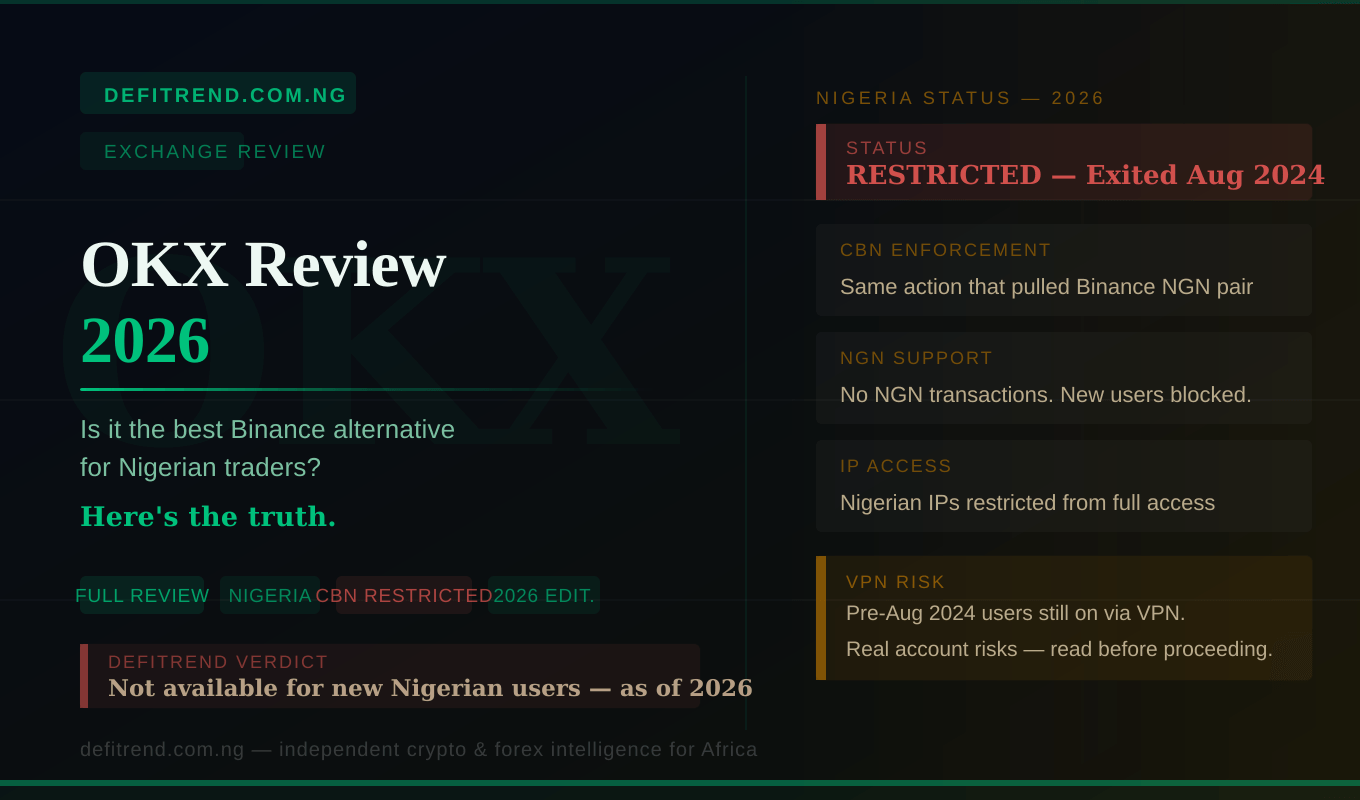
Nigerian verdict: The most underrated top-10 exchange for Nigerian traders. The OKX P2P desk supports NGN and is genuinely worth exploring as your primary Binance backup. The product quality is at least equal to Binance on the things that matter most.
8. Coinbase | Market Share: 6.1%

Coinbase is the only major crypto exchange publicly listed on a stock exchange (NASDAQ: COIN). It is the primary custodian for over 80% of US spot Bitcoin and Ethereum ETF assets — which attracted $31 billion in inflows in 2025 alone. In August 2025, Coinbase acquired Deribit, the world’s largest crypto options platform. Its SEC lawsuit was dismissed in March 2025.
What it is best at: institutional compliance and being the exchange where the biggest money in the world moves.
Nigerian verdict: Not available for Nigerian users. No NGN support. But watching Coinbase’s institutional custody inflows is one of the best leading signals for Bitcoin price direction. Keep one eye on it even if you are not trading on it.
9. HTX (formerly Huobi) | Market Share: 6.0%
HTX was one of the original big three crypto exchanges in 2017–2020. It was acquired by entities linked to Justin Sun and rebranded from Huobi to HTX. It carries significant Asian retail volume and has an active P2P desk.
What it is best at: specific altcoin pairs with deep Asian liquidity, and a long operating history with over $33 trillion in cumulative trading volume.
Weakness: The Justin Sun association raises real governance and counterparty risk questions for serious traders. CoinGecko’s 2026 Spot CEX data shows HTX has a high asset velocity ratio (1.44–2.04 range), meaning thin reserves relative to trading volume.
Nigerian verdict: Usable for specific altcoin pairs. But the ownership structure is a genuine concern — keep any exposure here small and withdraw profits quickly.
10. Upbit | Market Share: 5.5%
Upbit is South Korea’s largest crypto exchange and one of the top 10 globally. It processed $75 billion in quarterly volume in Q3 2025. It is heavily KRW (Korean Won)-focused and operates under South Korea’s strict Virtual Asset Service Provider licensing framework.
What it is best at: Korean retail volume and compliance within South Korea’s regulatory environment.
Nigerian verdict: Not accessible or practically relevant for Nigerian traders. Worth knowing that South Korea runs one of the most heavily regulated crypto markets in the world — Upbit’s existence inside that framework is interesting from a regulatory comparison perspective. But this is not your exchange.
TIER 3 — The Specialists and Regional Players (Positions 11–15)
Each of these has a specific use case. None should be your primary exchange, but each has a role for the right trader.
11. Kraken

Founded in 2011. Never had a major hack. Publishes quarterly Proof of Reserves verified by external auditors — its December 2025 PoR confirmed all major assets including BTC, ETH, SOL, USDT, and XRP are backed 1-to-1 and beyond. Its SEC lawsuit was dismissed with prejudice in March 2025. Named Best Crypto Trading Platform at the 2025 Finder Crypto Trading Platform Awards.
Nigerian verdict: Not your daily trading platform from Lagos. But Kraken’s PoR standard is the benchmark every exchange you use should be held to. Use it as your safety ruler.
12. Bitstamp
Founded in 2011. Acquired by Robinhood Markets in 2024. One of the oldest exchanges still operating. Strong European regulatory compliance and institutional credibility.
Nigerian verdict: Minimal direct relevance for Nigerian retail traders today. But Robinhood’s existing African market interests are worth watching — if that distribution channel develops, Bitstamp’s underlying infrastructure could become relevant here faster than expected.
13. KuCoin
Built its reputation on listing new altcoins early — often weeks or months before they hit Binance or OKX. In 2025, KuCoin was the only perpetual CEX outside the top 10 to cross $1 trillion in cumulative perp volume, according to CoinGecko’s 2025 Annual Report. But its regulatory standing weakened significantly after US DOJ charges in 2023.
Nigerian verdict: Useful for altcoin discovery and early positions in emerging tokens. Keep capital here small. It is a research tool, not a capital home. The regulatory situation makes it a place to trade, not a place to store.
14. Gemini
Founded by the Winklevoss twins. Regulated in New York under NYDFS. Carries $250 million per-user insurance coverage via the Aon syndicate. 100% cold storage for custody clients. Publishes monthly Proof of Reserves audits. One of the most secure exchanges operating in the US.
Nigerian verdict: Not accessible or relevant for most Nigerian retail traders. But if Gemini lists a new asset, it is a mainstream adoption signal — institutions are comfortable with it. Useful as an indicator, not as a trading platform.
15. Bitfinex
Owned by iFinex Inc. — the same parent company as Tether (USDT). Has deep OTC liquidity for large BTC/USD orders. Has faced significant controversy historically over questions about USDT reserve backing, which were partly settled with a 2021 agreement with the New York Attorney General.
Nigerian verdict: Avoid as a primary exchange. The Tether structural relationship is a counterparty risk most retail traders should not carry. The OTC desk is useful for very large orders, but that is not the use case for most Nigerian traders reading this.
TIER 4 — The Emerging and Niche Players (Positions 16–20)
Lower volume, higher specialization. Know what each one is for before depositing.
16. LBank
Founded in 2015. Serves users in over 160 countries. Lists over 800 cryptocurrencies across more than 1,000 trading pairs — strong on memecoins and niche altcoins. CoinGecko highlights LBank as a top exchange for driving the memecoin market with fast altcoin listings and deep memecoin liquidity. It supports fiat transactions via multiple payment methods.
Nigerian verdict: On the radar for African altcoin traders who want early access to trending small-cap tokens. Verify withdrawal routes before committing capital. Not a capital home — a trading tool for specific opportunities.
17. Phemex
Launched in 2019. Supports over 500 cryptocurrencies. Offers spot, futures, and margin trading with leverage up to 100x on certain contracts. Publishes Proof of Reserves via Merkle trees. Note: In January 2025, one of its hot wallets was exploited and $70 million was stolen. The exchange compensated affected users, but this is a real security event on the record.
Nigerian verdict: The zero-fee spot subscription model is interesting for high-frequency spot traders. But the 2025 hack puts it in a different risk category from the tier-1 exchanges. Proceed with caution and keep positions small.
18. BingX
A social trading and copy trading focused exchange that has made a visible push into emerging markets — including parts of Africa — in 2025 and 2026. Publishes monthly Merkle-tree Proof of Reserves. Maintains a $150 million Shield Fund and additional insurance coverage. High cold-storage ratio.
Nigerian verdict: The most Nigeria-relevant exchange in this tier. BingX’s African marketing push in 2025–2026 makes it one to watch — and its security posture (monthly PoR, Shield Fund) is better than most platforms at this ranking level. Worth exploring as a copy trading alternative if Bybit or Bitget waitlists are full.
19. CoinEx

Known for a wide altcoin selection and low fees. Offers a no-KYC option for smaller accounts, which has made it popular in markets with heavy KYC friction.
Nigerian verdict: Useful for specific privacy-conscious altcoin trades. But the no-KYC model is a double-edged sword — it attracts bad actors alongside legitimate users, and regulatory pressure globally is pushing all exchanges toward stricter verification eventually. Not a capital home.
20. Deepcoin

A derivatives-focused exchange that previously ranked in the global top-5 for contract trading volume in 2023. Has since seen volume redistribute toward larger competitors. Primarily targets Asian retail derivatives traders.
Nigerian verdict: Not relevant for most Nigerian traders today. Deepcoin’s niche is very specific — and for derivatives, Bybit and OKX serve that need at much higher liquidity and product quality. Monitor for any Africa-specific expansion signals but do not prioritize it.
Build a Four-Layer Exchange Stack — Not a Single Account
The lesson from 2024 is permanent: single-exchange dependency is a capital risk, not a temporary inconvenience.
Here is the framework that actually makes sense for a Nigerian trader in 2026:
Layer 1 — NGN On/Off Ramp (P2P) Primary: MEXC — zero fees, 300+ NGN payment methods, fast settlement. Backup: Bybit P2P and Gate.io (via app) — both have active NGN merchants. Rule: Have at least two working P2P accounts with KYC completed before you need them.
Layer 2 — Active Trading (Spot and Derivatives) Bybit for derivatives, copy trading, and clean execution. OKX for altcoin depth, Web3 tools, and the strongest security record in the top 10. Bitget as a secondary derivatives and copy trading option — underexplored and growing fast.
Layer 3 — Altcoin Discovery and Early Entry Gate.io and LBank for new listings before they hit the top-5 exchanges. KuCoin as a research tool — small positions, withdraw profits quickly. Rule: Never store significant capital on tier-3 or tier-4 exchanges. They are trading venues, not savings accounts.
Layer 4 — Institutional Signal Watching Monitor Coinbase custody inflows as a Bitcoin price direction signal. Use Kraken’s quarterly Proof of Reserves as your benchmark for evaluating every exchange you use. Watch Gemini new listings as a mainstream institutional adoption signal.
“Volume rank is not a safety rank. FTX was top-5 by volume the week before it collapsed. Use Proof of Reserves, regulatory standing, and withdrawal speed as your real safety metrics — not the CoinGecko leaderboard position.”
Top 10 Crypto Exchanges by Volume in 2026 — And What the Rankings Actually Tell Nigerian Traders
What the Top 20 Looks Like From Lagos
Here is the honest breakdown that no international exchange ranking post will give you.
Of the full top 20, roughly four to five exchanges have meaningful, active NGN P2P infrastructure right now in 2026: MEXC, Bybit, Gate.io, Bitget, and BingX at the lower tier. Binance — the biggest exchange in the world — no longer provides NGN services to Nigerian users. Coinbase is not available in Nigeria at all. Kraken has no NGN support. Upbit is Korean-focused. Gemini is US-only. Crypto.com has limited P2P options.
The access gap is not subtle. Most of the top 20 list does not apply to you as a Nigerian trader in the same way it applies to someone in London or Singapore.
The CBN and SEC Nigeria regulatory framework has continued to evolve in 2026. All licensed platforms now require TIN and NIN compliance for KYC. Quidax holds its provisional SEC Nigeria Digital Assets Exchange licence. Busha continues to operate under SEC oversight. These locally-licensed platforms exist as a complementary tier to the global top 20 — for traders who want Nigerian regulatory protection behind their transactions.
For all other global exchange access, USDT remains the bridge. The vast majority of Nigerian traders access the global top 20 not through direct naira deposits, but via USDT purchased on P2P platforms. That means the quality of an exchange’s USDT P2P infrastructure — merchant depth, settlement speed, NGN payment method support — matters more for Nigerian traders than any fiat deposit option.
The race for Africa is quietly underway. OKX, Bybit, MEXC, and BingX have all made visible moves toward African markets in 2025–2026 while Binance navigates its CBN relationship carefully. No exchange on this list has yet established a direct, licensed local entity in Nigeria. The first one that does will unlock a retail market that has been waiting for exactly that move.
My Read on the Top 20 Heading Into Q3 2026
What strikes me about the current top 20 is how much movement is happening in positions 6 through 15. Bitget, MEXC, and Gate.io are growing faster than their rankings suggest. Meanwhile, some of the legacy names in the 10–15 range are coasting on brand recognition while their product quality stagnates.
The most important single data point in this whole piece: according to CoinGecko’s 2025 Annual Report, positions 2 through 10 are all clustered within a tight 2.6 percentage point band of market share. That is an incredibly competitive field. One product launch, one regulatory misstep, or one major P2P expansion in the African market could reshuffle that order in a single quarter.
My calls for end of 2026: Bitget breaks into the top 5 by combined spot and derivatives volume. At least one exchange in the 16–20 range gets acquired or shuts down as regulatory pressure tightens globally. And the first top-20 exchange to establish a licensed local entity in Nigeria will change the entire landscape here in a way that has not happened yet.
Which exchanges from this list are you currently using — and which ones have surprised you in either direction? Drop it in the comments. Subscribe to the Defitrend weekly brief for our monthly exchange tracker built for African traders — we track NGN P2P depth, withdrawal speeds, and regulatory updates across every platform on this list so you do not have to.
Disclosure: This article is for informational purposes only and does not constitute financial or investment advice. Crypto trading carries significant risk of loss. Always verify exchange status, regulatory standing, and Proof of Reserves before depositing funds.



Leave a Reply