
Five exchanges now control most of all crypto trading activity on earth. Together, they process more trades in a single day than the Nigerian Stock Exchange sees in an entire year — many, many times over.
But here is what the global rankings keep getting wrong: volume rank and usability rank are two completely different things.
An exchange can be number two in the whole world by volume and still be completely useless for a trader in Lagos who needs to convert USDT to naira before a volatile NFP Friday. We have seen that play out. And if you were trading on Binance in early 2024, you already know exactly what that feels like.
This post breaks down the top five exchanges in plain, simple language. Not a spec sheet. Not a fee table copied from somewhere else. A real breakdown — with a clear verdict on which of these five actually deserves your capital if you are trading from Nigeria or anywhere in Africa.
How the Top 5 Got Here — and What Changed Between 2022 and 2026
To understand why these five are at the top in 2026, you need to understand one event: the FTX collapse in November 2022.
FTX was one of the biggest exchanges in the world. One week it was processing billions in trades. The next week, it was gone — and the people who had money on it could not get it out. It was one of the worst things to happen in crypto history.
When FTX collapsed, all the traders who were using it had to go somewhere else fast. Most of the volume went to Binance, Bybit, and OKX. Binance alone went from about 50% of global market share to nearly 65% almost overnight, according to TokenInsight data. Bybit picked up a big chunk of the derivatives traders.
Then in 2023, Binance itself went through a storm. The US Department of Justice hit it with a $4.3 billion settlement. The founder, CZ, stepped down as CEO. Most people expected this to hurt Binance badly. Instead, it made big institutions more comfortable using Binance — because cleaning up compliance signalled that the exchange was serious about staying for the long run.
Coinbase, meanwhile, had been fighting the US SEC in court since 2023. By 2025, that case was dismissed. And with Bitcoin and Ethereum spot ETFs now fully approved in the US, Coinbase became the exchange that the biggest money in the world — pension funds, hedge funds, banks — moved through. By Q2 2026, Coinbase has solidified its role as the primary custodian for the vast majority of US spot Bitcoin and Ethereum ETFs.
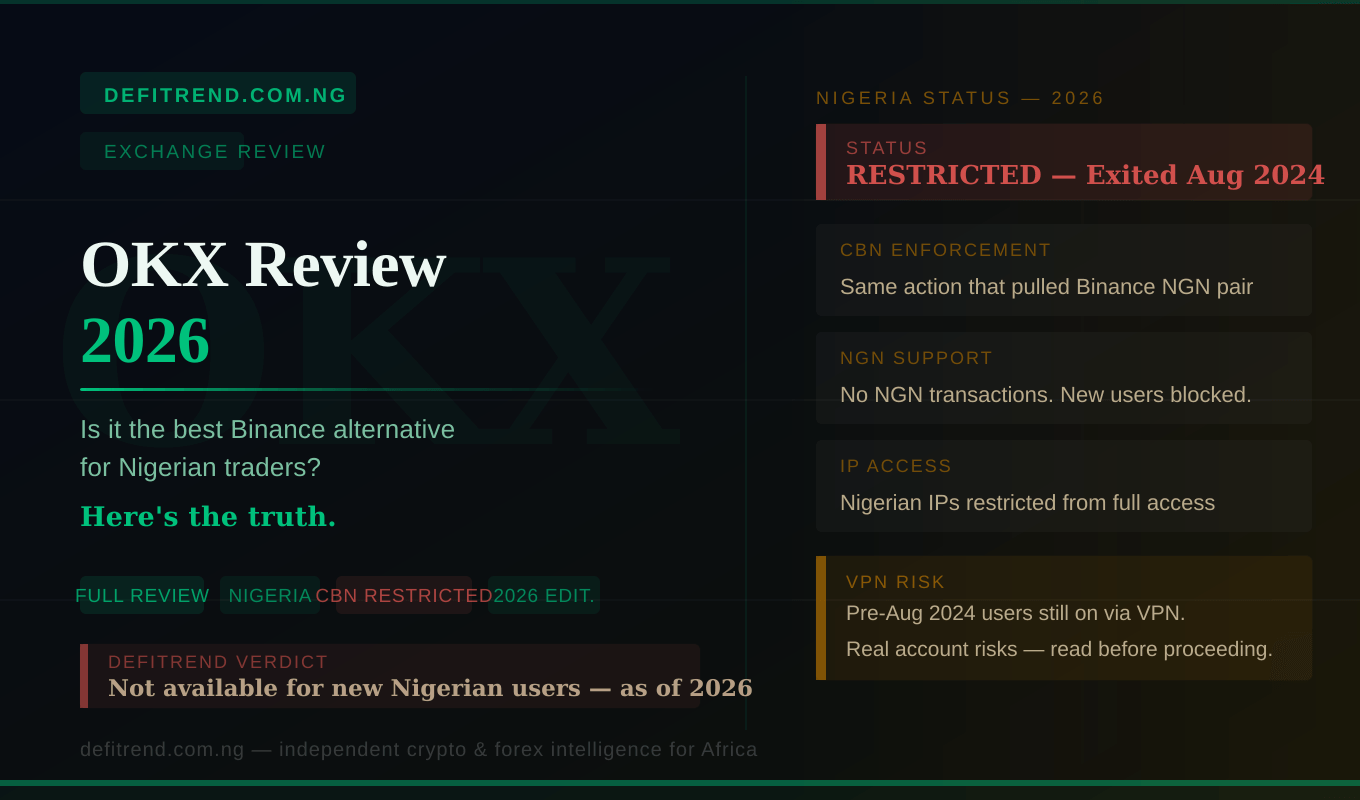
And for Nigerian traders specifically, the event that changed everything was the 2024 Binance-CBN standoff. Binance removed all NGN services — P2P, deposits, withdrawals, naira trading pairs — after the Nigerian government accused the platform of currency manipulation. Overnight, Nigerian traders who depended entirely on Binance for their NGN on-ramp lost that access. That moment is the reason why this ranking matters more to Nigerian traders today than it ever did before.
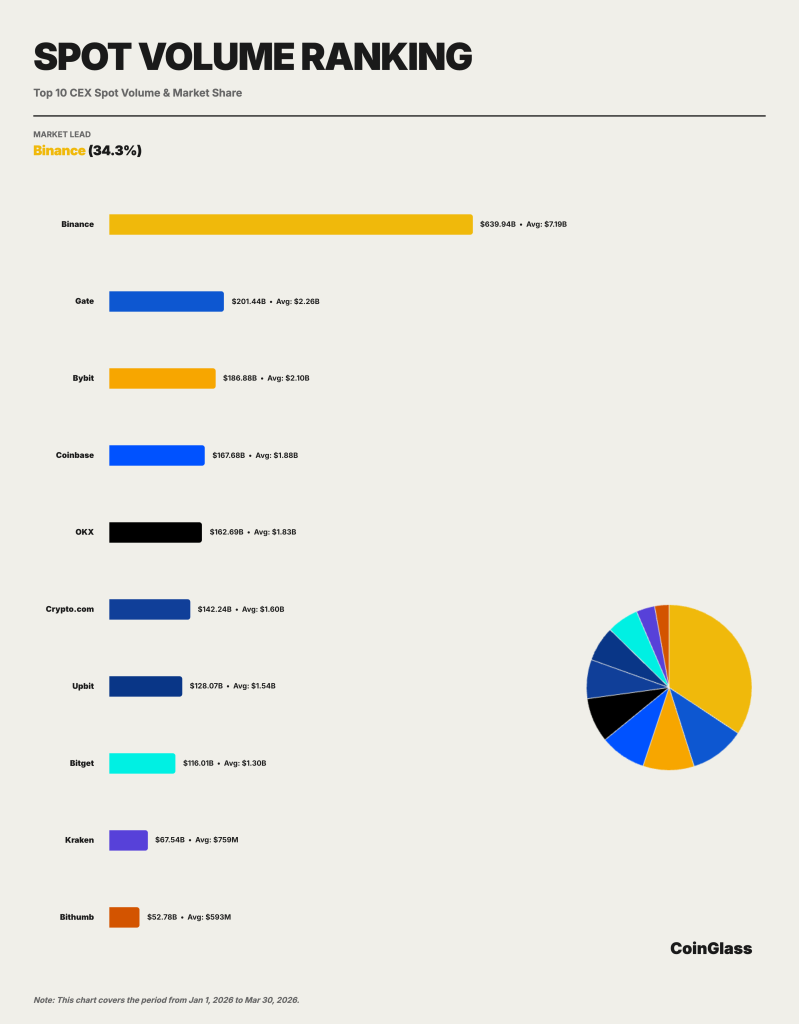
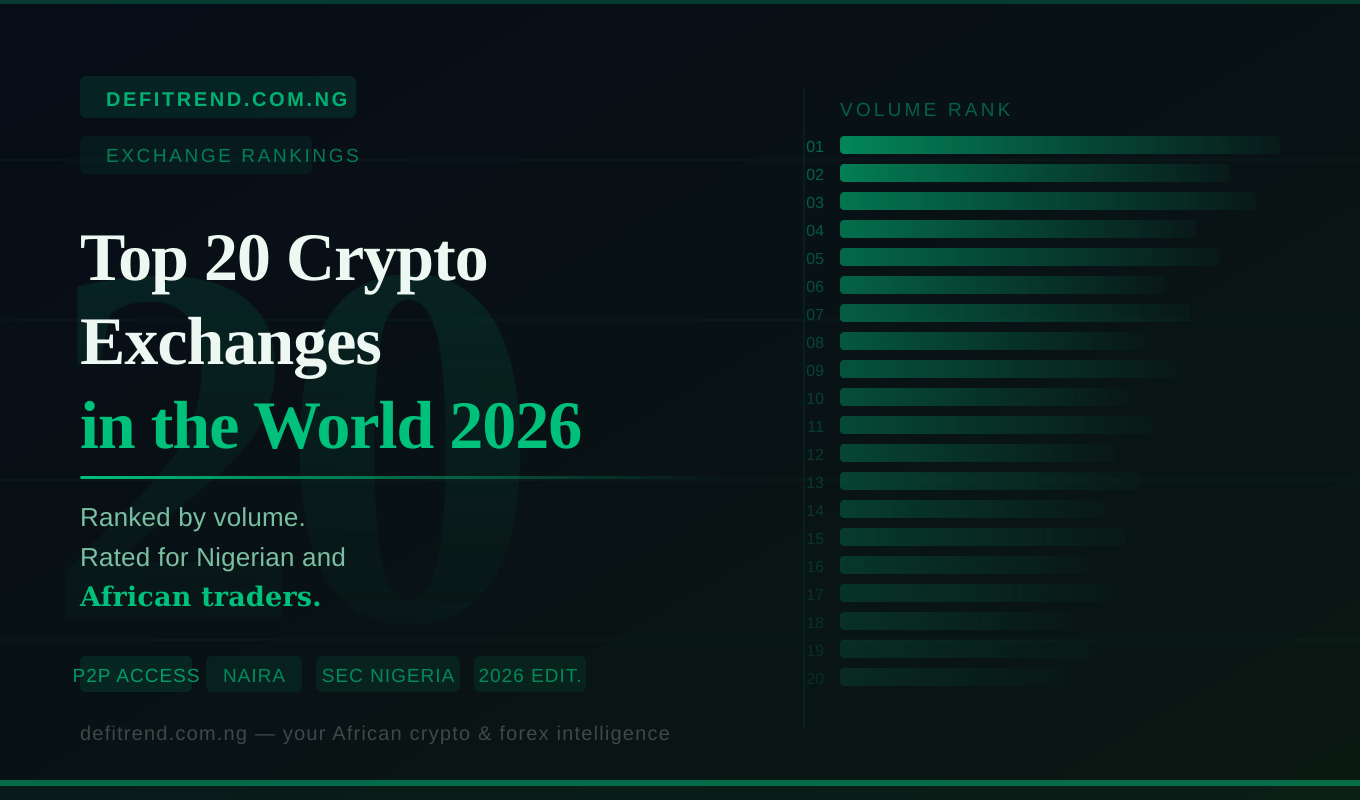
Top 10 Crypto Exchanges by Volume in 2026 — And What the Rankings Actually Tell Nigerian Traders
The Top 5 Crypto Exchanges in the World — What They Are Good At, and the Real Verdict for African Traders
1. Binance
What it is in simple terms: The biggest exchange on the planet. By far.
According to CoinGecko’s full-year 2025 data, Binance held a 39.2% share of all centralized exchange spot volume — out of a combined $18.7 trillion across the top 10. Think about that number. Out of every 10 dollars traded on a major exchange last year, roughly four of them went through Binance. No other exchange comes close.
In Q1 2026, CoinGlass data shows Binance held approximately 34.9% of derivatives volume among the top ten. User assets on Binance represent roughly 73.5% of all major CEX reserves combined — meaning Binance holds almost three times more trader funds than everyone else in the top 10 put together.
What Binance is best at: P2P trading. The USDT/NGN corridor on Binance P2P was — and remains in its global form — the deepest and most liquid in Africa. More merchants, tighter rates, and more payment options than any competitor. That is why Nigerian traders built their entire workflow around it.
The big weakness: Regulatory risk in Nigeria. The 2024 CBN standoff showed exactly what can happen. Binance’s relationship with Nigerian regulators is fragile, and a single policy shift can shut down your primary off-ramp with very little warning. The legal case is still in the Federal High Court in Abuja as of 2026. The exchange’s website requires a VPN to access from most Nigerian internet providers.
Verdict for Nigerian traders: Binance is still the most important exchange for understanding where the market is moving — its volume signals tell you where liquidity is concentrating globally. If you have an existing verified account, it still works for crypto-to-crypto trading. But if 2024 taught us anything, it is this: Binance should never be your only exchange again. Single-platform dependency on Binance is a capital risk, not just an inconvenience.
2, Coinbase
What it is in simple terms: The most regulated, most institutional crypto exchange in the world. The one that the biggest money uses.
Coinbase is the only major crypto exchange publicly listed on a stock exchange (NASDAQ: COIN). As of Q2 2026, it is the primary custodian for more than 80% of US spot Bitcoin and Ethereum ETF assets — which collectively attracted $31 billion in inflows in 2025 alone. In August 2025, Coinbase acquired Deribit — the world’s largest crypto options venue — giving it a dominant position in the derivatives market for institutional traders. Coinbase’s trading volume surged 28% year-on-year in 2025, reaching $234 billion in Q2 2025 alone.
What Coinbase is best at: Being the bridge between traditional finance and crypto. When pension funds, banks, hedge funds, and big corporations want to buy Bitcoin, they go through Coinbase. It is also the most legally protected exchange for US users — its SEC lawsuit was dismissed in 2025, and it now holds MiCA licensing in the EU.
The big weakness: Not available in Nigeria. Coinbase does not support Nigerian users. There is no NGN P2P, no naira deposit or withdrawal, and no direct access for most African traders. Fees are also higher than most other top-5 exchanges for retail users.
Verdict for Nigerian traders: You almost certainly cannot use Coinbase as your day-to-day trading platform from Nigeria right now. But here is why it still matters: watching Coinbase’s institutional custody inflows is one of the best leading signals for where Bitcoin is being positioned by the biggest players in the world. When institutions are moving large amounts into Coinbase custody, they are building positions. That tells you something before the chart does. Keep one eye on Coinbase even if you are not trading on it.
3. OKX
What it is in simple terms: A massive global exchange that most Nigerian traders have barely explored — and that is a mistake.
OKX is Hong Kong-headquartered, privately held, and one of the strongest platforms for both spot and derivatives trading globally. In September 2025, OKX’s derivatives volume hit $1.3 trillion in a single month — overtaking Binance in the derivatives market for the first time, according to CoinLaw data. OKX has never been hacked. It publishes monthly Proof of Reserves reports using Merkle Tree and zk-STARK technology, meaning anyone can independently verify that their funds are actually there.
What OKX is best at: Altcoin depth, Web3 tools, and a trading interface that is genuinely as good as Binance’s — sometimes better. The OKX Wallet is one of the most complete non-custodial wallets attached to any centralized exchange. OKX spot fees start at 0.08% maker / 0.10% taker — among the most competitive in the industry.
The big weakness: Brand recognition in Nigeria is nowhere near where it should be. Most Nigerian traders have never opened an OKX account, which means they are missing out on a platform with better security, competitive P2P, and altcoin liquidity that matches Binance on the things that matter most.
Verdict for Nigerian traders: In my view, OKX is the most underused top-5 exchange by Nigerian traders right now. The OKX P2P desk supports NGN and is worth exploring as your primary Binance backup. If you only add one new exchange account this year, make it OKX. The altcoin depth, the Web3 wallet, and the clean derivatives interface make it a complete package — and the fact that it has never been hacked while still operating at this scale is not a small thing.
4. Bybit
What it is in simple terms: The fastest-growing exchange in the top five, and the best one for derivatives and copy trading right now.
Bybit is Dubai-based, privately held, and has grown from a niche derivatives platform into one of the most complete exchanges in the world. It now has over 80 million registered users globally. In Q3 2025, Bybit held the third spot globally for derivatives volume, with $376 billion in quarterly derivatives trading. Its copy trading product is independently rated as the best in crypto — Master Traders are verified over 90 days of live trading, drawdown limits are built in, and the system stops automatically if a trader breaches their risk threshold.
In February 2025, Bybit was hit with the largest crypto hack in history — approximately $1.5 billion in ETH was stolen. Bybit replenished its reserves from its own balance sheet within 72 hours. No customer lost a single dollar. Since then, Bybit publishes monthly independent Proof of Reserves reports verified by Hacken.
What Bybit is best at: Derivatives trading and copy trading. The interface is cleaner, faster, and more intuitive than Binance Futures. For a Nigerian retail trader who wants to trade perpetual futures or follow a more experienced trader, Bybit is the right platform.
The big weakness: NGN P2P merchant depth is still smaller than Binance was at its peak — the merchant count is growing, but it is not at full parity yet. For very large NGN P2P volumes, you may still need to spread across multiple platforms.
Verdict for Nigerian traders: If you trade derivatives or use copy trading, Bybit should already be part of your setup. For NGN P2P, Bybit is now the most functional option available among the globally ranked top exchanges — and it is getting better. The combination of clean derivatives, solid copy trading, active NGN P2P, and rapid hack response makes Bybit the best-positioned top-5 exchange for Nigerian traders in 2026. Watch the NGN P2P merchant count in Q3 2026 — if it keeps growing at its current pace, this conversation looks completely different by year end.
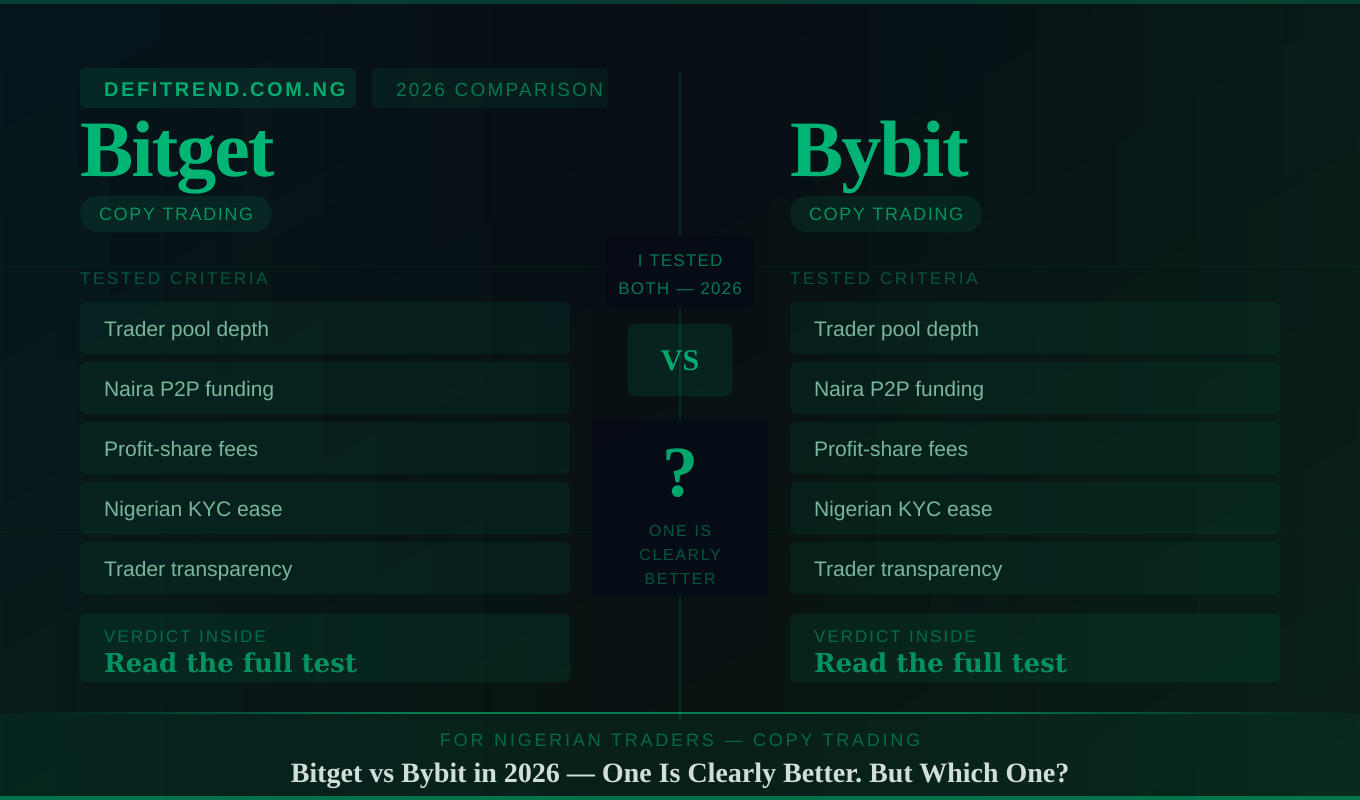
Binance vs Bybit in 2026 — A Nigerian Trader’s Honest Breakdown of Which Exchange Actually Delivers
5. Kraken
What it is in simple terms: The most trusted exchange in the top five. The one that has been around since 2011 and has never had a major hack.
Kraken is US-based, privately held, and built its reputation on one thing: security. It publishes quarterly Proof of Reserves reports verified by external auditors — its December 2025 PoR confirmed that all client assets including BTC, ETH, SOL, USDC, USDT, XRP, and ADA are backed 1-to-1 and beyond. Its SEC lawsuit in the US was dismissed with prejudice in March 2025. It holds a MiCA licence in the EU. In Q3 2025, Kraken processed $102 billion in volume with a 3.6% global market share, dominating euro-based trading pairs. Kraken was named Best Crypto Trading Platform at the 2025 Finder Crypto Trading Platform Awards.
What Kraken is best at: Safety, compliance, and being the benchmark that every other exchange should be measured against. Its Proof of Reserves process — using Merkle tree verification that any user can check themselves — is the industry standard.
The big weakness: No meaningful P2P support for Nigerian traders. No NGN services. Higher KYC friction. More US and Europe-focused than Africa.
Verdict for Nigerian traders: Kraken is probably not your day-to-day trading platform from Lagos. But Kraken’s PoR standard is the bar you should hold every exchange you use to. Ask yourself: does your primary exchange publish quarterly, independently verified Proof of Reserves? If not, that is a real question about where your funds actually sit. Use Kraken as your benchmark, even if you are not trading on it.
Don’t Pick One Exchange — Build a Stack
The lesson from 2024 is permanent: single-exchange dependency is a capital risk.
Here is a practical framework for how to structure your exchange setup as a Nigerian trader in 2026:
Tier 1 — Primary P2P and Spot (NGN On/Off Ramp) Your go-to for buying and selling USDT with naira. Right now, that is Bybit as primary — active NGN P2P, no CBN legal standoff, and growing merchant depth. Keep OKX P2P funded and verified as your backup rail. Have it ready before you need it.
Tier 2 — Derivatives and Active Trading Bybit for cleaner interface, copy trading, and competitive perpetual fees. Binance Futures remains useful for altcoin perp depth if you have an active account.
Tier 3 — Institutional Signal Watching Even if you never trade on Coinbase directly, monitor its institutional custody inflows. Coinbase is the custodian for over 80% of US Bitcoin ETF assets — when large institutional flows move, they move through Coinbase first. That is a leading signal most retail traders completely ignore.
Tier 4 — Your Security Benchmark Use Kraken’s quarterly Proof of Reserves publication as your reference point. Any exchange that is not doing this in 2026 is asking you to trust them without evidence. That is not a good deal.
“Never keep more on any exchange than you are actively trading. FTX was a top-5 exchange by volume the day before it collapsed. Volume rank is not the same as safety. Cold storage for anything you are not trading within 30 days.”
What the Top 5 Looks Like From Lagos, Not London
Of the entire top five, only Binance and Bybit have meaningful, active NGN P2P infrastructure — and Binance’s has been suspended for Nigerian users since 2024. OKX P2P supports NGN and is growing. Coinbase has no NGN access. Kraken has no NGN access.
This access gap is the single biggest thing the global rankings miss completely. When a site in London or New York publishes a “top five exchanges” post, they are writing for someone who can fund their account with a bank card or bank transfer in euros or dollars. That experience is completely different from what a trader in Port Harcourt deals with every day.
The Nigerian crypto market is evolving fast in 2026. CBN’s regulatory framework has been formalised. All transactions on licensed platforms now require TIN and NIN compliance under KYC rules. Quidax, Nigeria’s first SEC-licensed exchange, holds its provisional Digital Assets Exchange licence. Busha continues to operate under SEC Nigeria oversight.
The USDT bridge remains the backbone of Nigerian crypto activity. Most Nigerian traders access the global top-5 exchanges not through direct naira deposits, but through USDT P2P — buying USDT from a P2P merchant, transferring it to the exchange, and trading from there. That means the quality of a platform’s P2P NGN support matters more than its fiat deposit options.
For traders who want African regulatory accountability alongside global exchange access, FSCA-regulated brokers and SEC Nigeria licensed platforms provide a regional compliance anchor. Bybit holds regulatory registrations in Dubai (VARA) and several other jurisdictions. OKX has been building regional infrastructure quietly.
This is the paragraph no exchange review in New York will ever write. If you are reading this from Nigeria, this section is built for your reality.
My Honest Take on the Top 5 Heading Into Q3 2026
The top 5 list is more stable than it has been in years. But that stability is a bit misleading.
Bybit is growing faster than its current ranking suggests. OKX is building infrastructure — in Web3, derivatives, and regional markets — that will matter more in 12 months than it does today. And DEX volume sitting at 21.7% of all global spot crypto trading is the slow-moving story that almost nobody in the mainstream conversation is taking seriously enough.
My call: Bybit overtakes Coinbase for the number two spot in combined spot-and-derivatives volume before the end of 2026. And at least one top-5 exchange makes a direct regulatory filing in Nigeria or Kenya before Q1 2027. When that happens, the P2P landscape here changes overnight.
The exchange that wins Nigeria wins Africa. That is the prize on the table. Watch which of the top five moves first.
Which of these five do you actually use — and which one has let you down? Drop it in the comments. Subscribe to the Defitrend weekly brief for our monthly exchange tracker built for African traders — we track NGN P2P depth, withdrawal speeds, and regulatory updates so you don’t have to.
Disclosure: This article is for informational purposes only and does not constitute financial or investment advice. Crypto trading carries significant risk. Always verify exchange status and regulatory standing before depositing funds.



Leave a Reply