
Every Nigerian crypto trader knows Binance. Most know Bybit. Almost nobody talks about OKX — and for a long time, that was a genuine mystery. Because by most product measurements that matter, OKX is one of the best three exchanges in the world. Deep derivatives. Tight fees. The best non-custodial Web3 wallet attached to any centralized exchange on earth. And yet, by the time Nigerian traders started looking OKX’s way in 2024 — the exchange was already packing its bags.
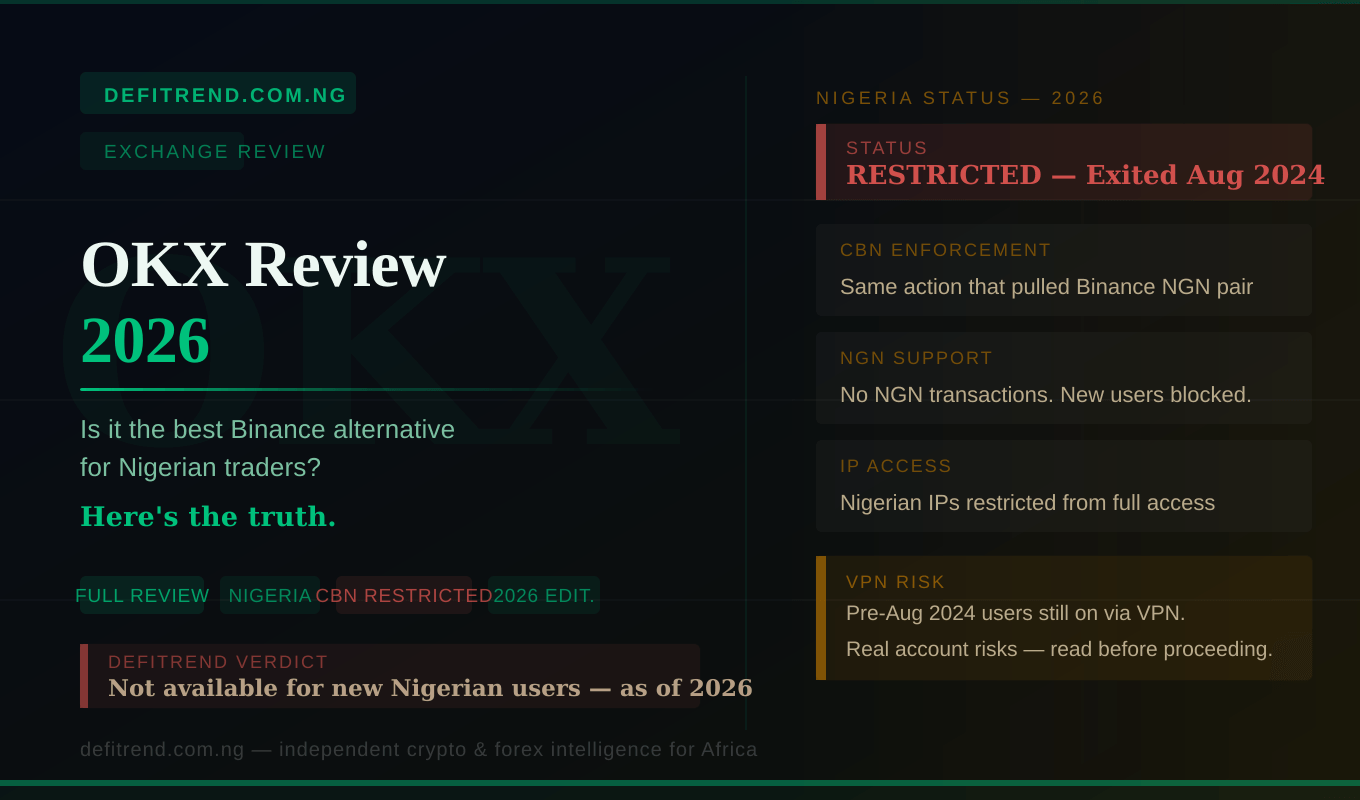
Here is the honest, fully updated picture: OKX officially exited Nigeria in August 2024, following the same CBN enforcement action that drove Binance to pull its NGN pair. As of mid-2026, OKX does not accept new Nigerian users, does not support NGN transactions, and Nigerian IP addresses are restricted from full platform access. Some traders who registered before August 2024 continue to use the platform via VPN — but that comes with real account risks that you need to understand before proceeding.
This is not the review the original outline planned to write. But it is the honest one — because putting out a “10 reasons to use OKX in Nigeria right now” article when OKX does not formally operate here would be doing you a disservice.
What this review does instead: explains exactly what OKX is, why it left, what Nigerian traders who still access it need to know, what the legal and account risks are, and what the global product offers for traders in jurisdictions where OKX is fully available. Because OKX is genuinely world-class — and the situation in Nigeria is not permanent.
OKX in 2026 — From Crypto Exchange to Full Web3 Platform
OKX was founded in 2017 by Star Xu as OKEx, a Hong Kong-based crypto exchange. In 2022, it rebranded to OKX — dropping the “exchange” from the name to signal its shift into a broader “Web3 platform” identity. That move was not just marketing. The exchange has since built one of the most complete product suites in crypto: spot trading, derivatives, options, an integrated non-custodial Web3 wallet, a DEX aggregator, NFT marketplace, trading bots, copy trading, and a launchpad for new token listings.
In February 2025, OKX resolved a $505 million DOJ settlement for AML violations and restructured its compliance program. Far from hurting the exchange, this settlement — like Binance’s own DOJ case — ended up building institutional confidence. In March 2026, ICE (the parent company of the New York Stock Exchange) made a strategic investment in OKX at a valuation of $25 billion. That is not an investment a company like ICE makes in a platform it is not confident about.
OKX also secured a partnership with BlackRock’s BUIDL framework through Standard Chartered, holds a full MiCA licence covering all 30 European Economic Area states, a UAE derivatives licence through VARA, and AUSTRAC registration in Australia. The exchange serves over 50 million users across more than 160 countries.
And it publishes monthly Proof of Reserves using zk-STARK and Merkle tree verification — meaning any user can independently confirm that their funds are backed 1-to-1. The October 2025 report was the 36th consecutive monthly PoR, showing 100%+ coverage on all major assets. That consistency is the industry benchmark.
OKX is, by every global product metric, a first-class exchange. The Nigeria problem is not a product problem. It is a regulatory one.
Why OKX Left Nigeria — And What Actually Happened
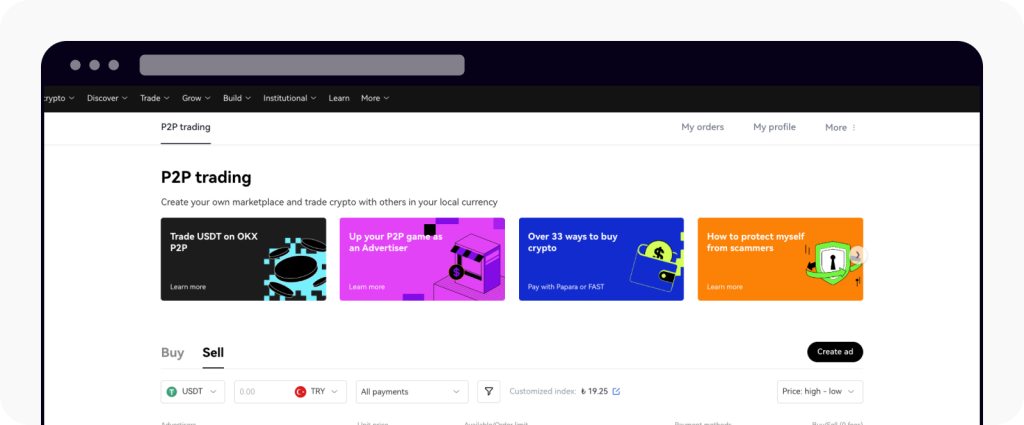
To understand OKX’s Nigeria exit, you need to understand the timeline.
February 2024: The Nigerian Communications Commission (NCC), backed by the CBN and the Presidency, directed Nigerian telecoms and internet providers to block several major crypto exchanges — including Binance, Coinbase, OKX, Kraken, and Bybit. The stated reason was that P2P platforms were being used to trade naira in ways that worsened the currency’s devaluation. Users on MTN and Glo networks suddenly found crypto websites unreachable without a VPN.
May 2024: OKX suspended its P2P feature for Nigerian users and removed the Naira from its platform. USDT and other crypto trading was still technically available, but the NGN on-ramp was gone.
July 17, 2024: OKX sent an email to all Nigerian customers titled “Action required: Notice regarding your account.” The message was direct: “We are discontinuing OKX services in Nigeria after recent changes in local laws and regulations.”
August 16, 2024: OKX officially exited Nigeria. From that date, Nigerian users could no longer open new positions or access any services on the platform — only withdrawals and the closing of existing positions were permitted.
Binance vs Bybit in 2026 — A Nigerian Trader’s Honest Breakdown of Which Exchange Actually Delivers
OKX was the second exchange to do this after Binance, and it was part of a broader pattern. According to Cryptonews and multiple Nigerian outlets covering the period, KuCoin also exited around the same time. The three exits in quick succession sent a clear message: international offshore exchanges without Nigerian regulatory licenses were not willing to absorb the legal and operational risk of continued operation in the market.
As a result of those exits, locally compliant exchanges gained a major competitive advantage. Quidax — which holds a provisional ARIP Digital Assets Exchange licence from Nigeria’s SEC — and Busha emerged as the primary licensed alternatives for Nigerian traders who needed regulated, locally accountable platforms.
Can Nigerian Traders Still Use OKX in 2026?
This is the question Breet’s 2026 Nigeria-focused OKX guide answers directly, and the answer is nuanced.
Technically, yes — with restrictions and risks.
Nigerian users who registered before August 2024 can still log into OKX through the website or app using a VPN. Some continue to use the platform for crypto-to-crypto trading and Web3 wallet features. The platform is not entirely inaccessible — it just does not formally serve Nigerian users.
But here is what you need to know before proceeding:
Account suspension risk. OKX may freeze accounts that are detected using Nigerian payment rails or IP addresses that are inconsistent with their compliance requirements. If your account is flagged, access to funds may be temporarily suspended while compliance checks are completed.
KYC complications. OKX requires NIN (National Identification Number) or BVN (Bank Verification Number) for Nigerian users, but account verification for Nigeria is officially paused. If your KYC needs updating, you may hit a wall.
Regulatory exposure. Nigeria’s Investment and Securities Act (ISA), signed by President Tinubu in March 2025, requires all crypto exchanges serving Nigerian users to hold an ARIP provisional licence from the SEC. OKX does not currently hold one. Operating through a platform that does not have this licence technically puts you in a grey zone under the 2025 framework.
No local support. If something goes wrong with your OKX account from Nigeria — a withdrawal hold, a disputed P2P transaction from before the exit, a frozen balance — you have no local support channel and limited legal recourse.
The honest verdict on VPN access: It works in practice for existing users who understand these risks. But it is not a setup for new traders, and it should not be your primary exchange if you are trading from Nigeria. For that role, Bybit, MEXC, and licensed local platforms like Quidax and Busha are the correct choice in 2026.
Top 10 Crypto Exchanges by Volume in 2026 — And What the Rankings Actually Tell Nigerian Traders
What OKX Actually Offers — The Full Product Review
Even though OKX does not currently operate in Nigeria, understanding what the platform offers is valuable for three reasons: (1) the situation is not necessarily permanent — OKX could re-enter Nigeria if the regulatory environment stabilizes; (2) Nigerian traders who travel or relocate internationally will encounter OKX in other markets; and (3) OKX’s product quality is genuinely the benchmark against which other exchanges should be measured.
Fees
OKX’s base spot fees start at 0.08% maker / 0.10% taker, dropping to negative maker fees at high volume tiers. This is already better than Binance’s standard 0.10%/0.10% at the base level, before any OKB token discount is applied. Holding OKB (OKX’s native token) reduces fees further — similar in structure to Binance’s BNB discount model.
For derivatives, fees are even lower: 0.02% maker / 0.05% taker at base level — competitive with Bybit at equivalent tiers.
Verdict: Among the most competitive fee structures in the top 5. For active traders doing meaningful volume, the cost savings versus Binance’s standard rate are real.
Spot Trading
OKX offers 300+ cryptocurrencies and 500+ trading pairs, with monthly proof-of-reserves reporting, staking, bots, copy trading, and a Web3 wallet ecosystem, making it a strong choice for users who want trading, earning, and on-chain access in one place.
Order book depth on BTC/USDT and ETH/USDT is institutional grade — tight spreads even during volatile sessions. The unified account structure means your collateral works across spot, margin, and derivatives without constant transfers. That is a genuine capital efficiency advantage for active traders.
Derivatives
OKX’s live markets include spot, margin, convert, P2P, and OTC. Margin is available on supported pairs up to 10x. Perpetual swaps with leverage up to 125x are available on select pairs, alongside quarterly futures contracts and European-style options.
OKX ranks among the top-3 globally in derivatives volume consistently. In September 2025, OKX briefly overtook Binance in monthly derivatives volume — the first time that had ever happened — before settling back into the number two or three position by year end.
Copy trading is available with a network of over 8,000 lead traders. This is more traders than Bybit’s pool, though Bybit’s verification system and performance transparency remain more rigorous. OKX’s copy trading is capable but not the class leader.
OKX Web3 Wallet — The Genuine Differentiator
This is OKX’s strongest product — and the one that gets the least attention from traders who only think of it as a CEX.
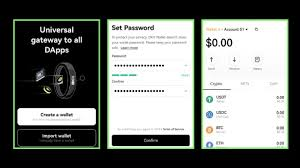
OKX Wallet is a non-custodial hot wallet supporting broad multichain coverage with a built-in DEX aggregator and cross-chain tooling, allowing users to manage assets, swaps, and dApp activity across many networks from one interface without leaving the wallet.
The OKX Web3 Wallet supports 100+ blockchains, including a built-in DEX aggregator called X Routing, NFT marketplace access, and a dApp browser. DEX activity through OKX Wallet nearly quadrupled in 2025, with significant engagement on Base, Solana, and other growing networks.
In plain language: OKX Wallet is what MetaMask would look like if it were built by a team with unlimited engineering resources and a fully integrated CEX behind it. You can swap tokens across 100+ chains, find the best prices across 200+ DEX protocols simultaneously, bridge assets across chains without a third-party bridge, and access DeFi protocols — all without leaving a single app.
Why does this matter for Nigerian traders even now? Because the Web3 wallet works independently of OKX’s regulated exchange operations. A Nigerian trader can use the OKX Web3 Wallet for on-chain DeFi activity — swapping USDT, accessing yield protocols, bridging to new chains — without the same regulatory friction that applies to the centralized exchange side. The wallet is non-custodial (you hold your own keys), which puts it in a different regulatory category from the exchange.
Verdict: The OKX Web3 Wallet is the best non-custodial multi-chain wallet attached to any centralized exchange in the world. Even traders who cannot use the OKX exchange should consider the wallet for DeFi and on-chain activity.
Security
OKX publishes a monthly proof-of-reserves report with public wallet balances and a Merkle tree of user liabilities. The October 2025 report marked the 36th consecutive month and showed 100%+ coverage on major assets.
OKX stores 95% of assets in cold wallets, with hot wallets maintaining only operational liquidity requirements. The platform offers strong security measures with monthly Proof of Reserves audits showing BTC and ETH holdings exceeding 100%.
There has been no major security breach of OKX’s main exchange infrastructure. The 2021 withdrawal freeze was regulatory — triggered when founder Star Xu was detained by Chinese authorities — not a hack. Since then, OKX has rebuilt trust through consistent PoR publication, expanded regulatory licensing, and the DOJ settlement compliance restructure.
Verdict: Security posture is genuinely strong. The 36-month consecutive PoR streak and the ICE/BlackRock institutional partnerships in 2026 signal a platform that is being held to institutional accountability standards.
OKX Pay and the Card Product
OKX Pay, launched in April 2025, offers zero-fee global crypto transfers supporting USDC and USDT without transfer limits or fees. It includes a “silent rewards” feature that automatically generates yield on deposits. The OKX Card (Mastercard debit) is currently live in Brazil with zero issuance fees and zero FX markup on international purchases.
The OKX Card is not yet available in Nigeria or most of Africa. But the zero-fee USDT transfer rails of OKX Pay are interesting for Nigerian traders who hold OKX accounts from before the August 2024 exit — it provides a low-cost way to move stablecoins between wallets.
What This Means for Nigerian Traders — An Honest Assessment
Let us be direct about where this leaves you.
If you are a new Nigerian trader in 2026: OKX cannot be your primary exchange. It does not accept new registrations from Nigeria. The correct primary exchange setup for Nigerian traders right now is Bybit for derivatives and P2P, MEXC for zero-fee P2P and spot, and a locally licensed platform like Quidax or Busha for SEC Nigeria-compliant transactions.
If you registered on OKX before August 2024: You can still access the platform via VPN with the risks described above. Many experienced Nigerian traders continue to use OKX for crypto-to-crypto trading and the Web3 wallet. If you proceed, keep positions here as part of a diversified stack — not your primary capital home. Never hold more on OKX (or any exchange) than you are actively trading.
How to Start Crypto Trading Step by Step 2026 (Beginner’s Guide)
If OKX re-enters Nigeria: Pay attention. According to Nigeria’s crypto regulatory evolution outlined by the Association of International Financial Professionals (AINFP), the exits of Binance, OKX, and KuCoin actually accelerated the regulatory framework — clearing the path for properly licensed exchanges to operate. As that framework matures, there is a genuine case for OKX to re-apply for ARIP licensing under the ISA 2025 framework and return to the Nigerian market. The ICE investment and the global compliance restructure make that path more credible now than it was in 2024.
The question is not whether OKX is a good exchange. It is — arguably the best in the world for traders who want derivatives, Web3, and low fees in a single platform. The question is when and whether OKX will decide Nigeria is worth the regulatory investment.
My Honest Verdict for 2026
OKX is the most impressive exchange that Nigerian traders currently cannot fully use. That tension — world-class product, formal market exit — is the entire story.
For traders in the 160+ countries where OKX operates normally, it deserves serious consideration as a primary exchange. The fees are competitive, the derivatives are deep, the PoR publication is exemplary, and the Web3 wallet is class-leading. The ICE investment and BlackRock partnership signal institutional credibility at a level few exchanges outside Coinbase can match.
For Nigerian traders, the move is to understand OKX well, watch the regulatory developments closely, and build your primary stack on exchanges that are currently active and accessible here — Bybit, MEXC, Bitget, and the locally licensed platforms.
The next 12 months of Nigeria’s SEC licensing process will decide whether OKX comes back. Watch the ARIP registration list at the SEC Nigeria website. That is the real signal.
Have you been using OKX from Nigeria via VPN? What has your experience been with the account risks? Drop it in the comments. And subscribe to the Defitrend weekly brief for the latest on exchange regulatory updates in Nigeria — we track which platforms are moving toward formal compliance and which are staying in the grey zone.
Disclosure: This article is for informational purposes only and does not constitute financial or investment advice. Using exchange platforms that have formally exited your jurisdiction carries regulatory and account risk. Always review the current terms of service and regulatory status of any platform before depositing funds.

Leave a Reply