

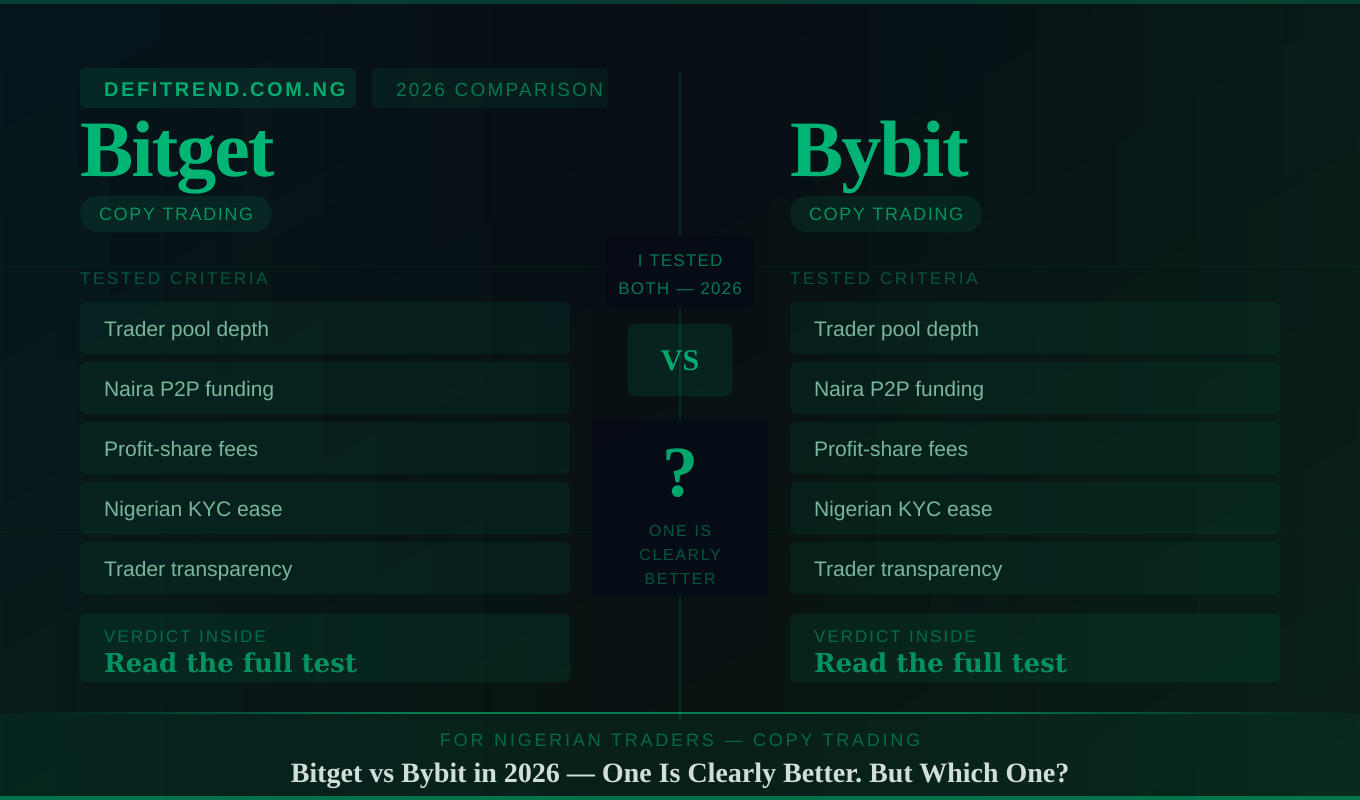
Copy trading has quietly become the most used feature in retail crypto — and also the most misunderstood.
Millions of traders are copying positions right now without fully understanding the fees eating their returns, the slippage gap between the signal trader’s entry price and their own, or the fact that the 90-day ROI numbers on every leaderboard are some of the most carefully selected statistics in the industry.
I have spent real time inside both platforms. Bybit and Bitget are the two exchanges that have built the most serious copy trading products in all of crypto in 2026. Both are good. But they are not equal — and for a Nigerian trader specifically, the difference matters more than any review written from London or New York will ever tell you.
By the end of this post, you will know exactly which one to use — based on your experience level, your capital size, and the NGN withdrawal reality that affects every profit you make on either platform.
How Copy Trading Became the Fastest-Growing Feature in Retail Crypto
Copy trading is a simple idea: instead of placing trades yourself, you connect your account to an experienced trader. When they buy, you buy. When they sell, you sell. You pay them a small share of your profits when you make money.
That sounds like a shortcut. In some ways it is. But here is what the marketing never tells you: most copy trading followers lose money — not because the signal traders are bad, but because of fee drag, slippage on entries and exits, and the habit of panicking and closing copied positions manually before the strategy plays out. Understanding that before you start is the only honest introduction to this product.
With that said, done correctly and with the right trader selection, copy trading genuinely works. Brokerchampion’s April 2026 review of Bybit’s copy trading tested three traders at $500 each over 14 days — tracking error against the lead trader was inside 0.8% in all three cases. That is real performance replication.
The growth of copy trading in Nigeria specifically has been sharp since 2024. After the Binance P2P disruption, many Nigerian traders moved to Bybit and Bitget and discovered copy trading for the first time. Social media — Instagram pages, Telegram groups, WhatsApp communities — has amplified the FOMO around copy trading returns. That social-media-driven growth is exactly why the platform and trader selection you make matters so much. The recommended trader in a WhatsApp group may have strong 30-day numbers and catastrophic 12-month ones.
OKX Review 2026 — Is It the Best Binance Alternative for Nigerian Traders? (Here’s the Truth)
Bybit launched its copy trading product first and built the larger signal trader pool. Bitget responded by making copy trading a central part of its brand identity — not a feature, but a core differentiator. By 2026, Bitget has built the largest verified lead trader database in crypto. The competition between these two platforms is the most interesting head-to-head in retail crypto right now.
Bitget vs Bybit Copy Trading — Every Category That Actually Matters
Signal Trader Pool — Where the Real Difference Lives
This is the most important category. The quality of the traders you can copy determines everything else.
Bitget has the larger raw numbers. According to data current as of early 2026, Bitget now has over 190,000 elite traders and more than 800,000 followers who have collectively executed over 100 million copy trades, with gains exceeding $530 million in total. CoinCodeCap’s April 2026 review states that Bitget has more lead traders with six-month-plus verified histories than Bybit or BingX. Three types of copy trading are available on Bitget: spot copy, futures copy, and bot copy — more variety than most exchanges offer.
Bybit has the deeper institutional quality at the top of the pool. Each lead trader on Bybit shows verified 180-day P&L, max drawdown, average trade duration, and win rate. Brokerchampion’s independent April 2026 test found that the tracking accuracy was inside 0.8% against lead traders in real conditions — a genuinely strong result. Bybit’s Classic mode lets followers track up to 10 Master Traders simultaneously. Its Pro mode operates more like a managed fund, where you buy into a trader’s strategy by purchasing shares of it. Its TradFi mode gives access to traditional markets — Forex and commodities — through an MT5-style setup.
The leaderboard manipulation problem affects both platforms equally. Traders who optimize for 30-day ROI display metrics rather than sustainable long-term performance exist on both Bybit and Bitget. The filter that cuts through this: look for traders with a minimum 90-day track record, maximum drawdown under 30%, win rate above 55% on at least 200 completed trades, and a profit factor above 1.3. CoinCodeCap recommends filtering specifically for “6+ month track record AND max drawdown under 15%” before looking at returns at all.
Verdict: Bybit wins on depth of institutional-grade traders with longer verifiable histories and a more rigorous filtering system. Bitget wins on raw trader count and particularly on recent quality in BTC and ETH perpetual strategies. For a brand new copy trader, Bybit’s 180-day verified P&L data gives you more to work with before you commit capital.
Fee Structure — What Is Actually Coming Out of Your Returns
This section matters because nobody breaks it down clearly enough for regular traders.
Bybit copy trading fees:
- Profit share: Master Traders set their own rate — typically 8–15% of follower profits on Classic mode, up to 30% on Pro mode
- No additional platform fee on copy trading beyond standard trading fees
- Derivatives trading fees: 0.02% maker / 0.055% taker on perpetual contracts
- Followers pay standard trading fees on every copied order — on high-frequency signal traders, this compounds fast
- High water mark applies on Pro mode: profit sharing only resumes when the strategy exceeds its prior NAV peak, meaning the trader cannot charge you again for recovering from losses inside the same settlement cycle
Bitget copy trading fees:
- Profit share: Elite Traders set their own rate, typically 8–15% for futures copy trading; spot copy trading is capped at 10%
- Followers only pay this share when trades are actually profitable — no upfront fee for the copy service
- Slippage limits are built in: Bitget applies default slippage limits of 0.3% for BTC and ETH, and 0.5% for other tokens on spot copy trading
- Derivatives trading fees: 0.02% maker / 0.06% taker on futures — marginally higher taker fee than Bybit
The compounding fee reality: a signal trader running 50 trades per week with a 10% profit share and standard taker fees can silently consume 20–30% of follower gross returns before withdrawal. This is not a scam — it is just mathematics. Understanding it before you start is how you select traders whose alpha is large enough to absorb both the fee drag and the slippage gap.
Verdict: Bybit’s lower taker fee (0.055% vs 0.06%) gives it a narrow mathematical edge on high-frequency futures copy strategies. For most Nigerian traders copying moderate-frequency traders, the fee difference is small enough that trader selection matters far more than which platform you are on.
Platform Interface — What You Actually See
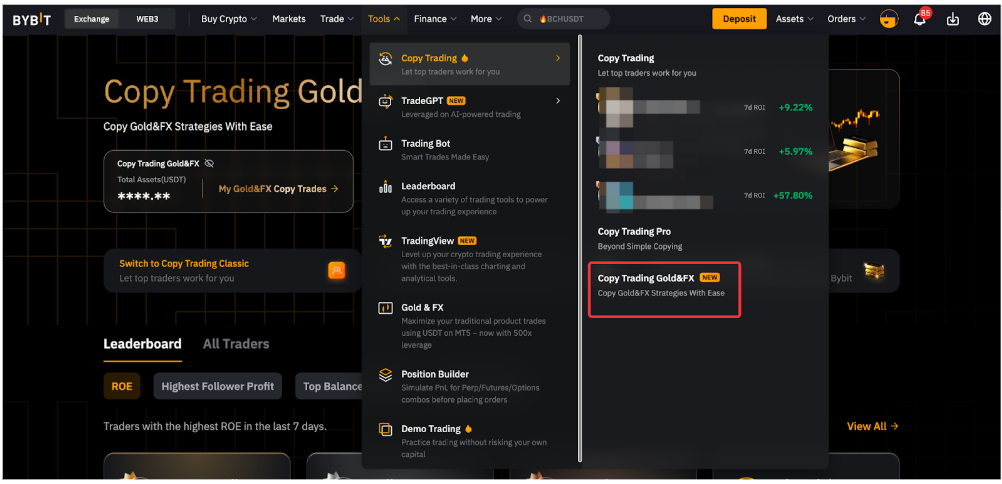
Bybit’s copy trading dashboard is well-organized and data-rich. Signal trader profiles show detailed stats including P&L history, asset allocation, max drawdown charts, win rate, average trade duration, and follower count. The filtering tools are powerful — experienced traders who know which metrics to prioritise will find exactly what they need. The mobile app copy trading experience is smooth and fast. Bybit now also has a CopyGuard feature launched in April 2026 — offering Loss Coverage Program vouchers of up to $100 USDT for new users and up to $50 USDT for returning traders who resume copy trading. This reflects Bybit’s post-hack focus on rebuilding trust with retail followers.
Bitget’s copy trading UI is arguably more beginner-friendly. The layout is simpler, performance summaries are cleaner, and the “One-Click Copy” feature reduces setup friction for first-time copy traders significantly. There is less data on screen — which can feel limiting for experienced traders but is genuinely less overwhelming for a complete beginner who might freeze in front of too many variables.
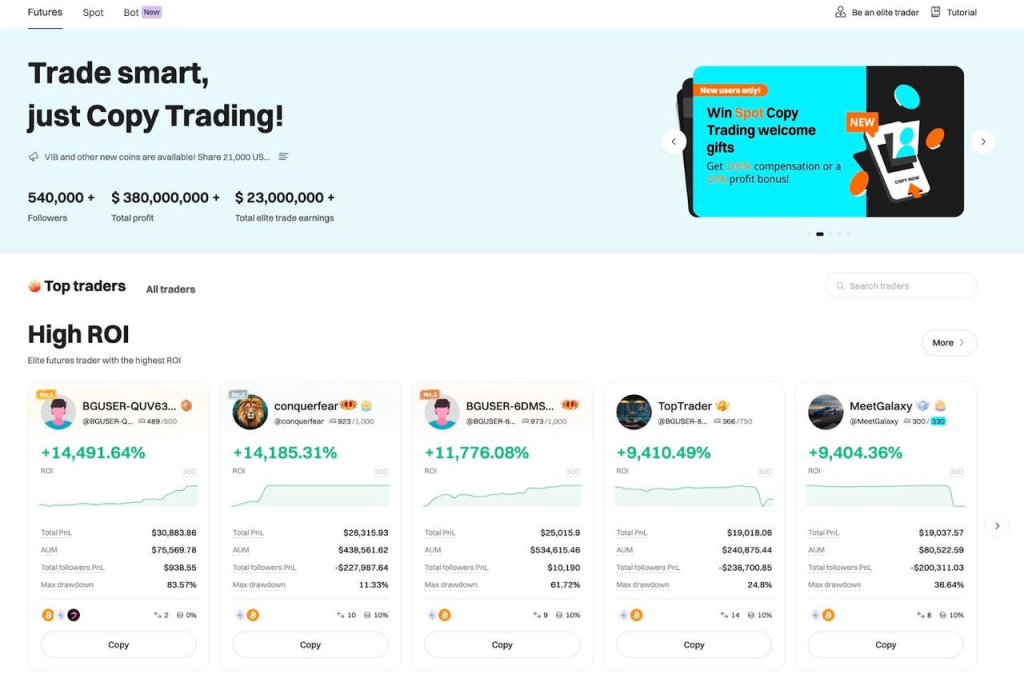
Verdict: Bybit for experienced traders who want granular data. Bitget for beginners who want simplicity. If you are copying your first trade ever, Bitget’s interface will serve you better. If you have been trading for six months or more, Bybit’s filtering depth is the better tool.
Signal Trader Incentives — Why This Affects the Quality of Who You Can Copy
The structure that attracts signal traders to each platform determines who shows up in the pool you copy from.
Bybit: Signal traders earn profit share only — no base salary, no platform subsidy. This selects naturally for traders who are genuinely confident in their own performance because they only earn when their followers profit. It also means Bybit’s Master Trader pool trends toward traders with conviction-based strategies rather than traders who join for the guaranteed income component.
Bitget: The Elite Trader program has a formal application and review process. Traders must meet strict performance criteria including minimum profit thresholds, consistent trading records, and controlled drawdown before qualifying. This vetting system creates a curated tier above the general pool. According to TradeAlgo’s February 2026 copy trading guide, Bitget’s Elite Trader program requires a minimum 30-day track record, positive ROI, and controlled drawdown for initial qualification.
2026 industry rankings from both Finestel and Bitget Academy gave the top copy trading spot to Bitget specifically for execution reliability and verified lead trader count. AOTrading’s May 2026 synthesis noted this directly — while Bybit holds the strongest derivatives liquidity for large institutional positions, Bitget’s curated elite trader pool performs better on verified lead trader count metrics.
Verdict: Both incentive structures have strengths. Bybit’s pure profit-share model naturally aligns Master Trader income with follower outcomes. Bitget’s vetting process brings better-screened traders to the pool upfront. For followers: verify track records carefully on Bitget because the qualification criteria shape who you are copying, not just their recent numbers.
Asset Coverage and Copy Strategy Types
Bybit offers copy trading across perpetual futures (the primary use case), spot trading (growing), and traditional financial markets via TradFi mode. Strategy diversity is wider — scalpers, swing traders, grid strategy traders, and long-only spot copyists are all active on the platform. Followers can track up to 10 Master Traders simultaneously in Classic mode.
Bitget offers spot copy, futures copy, and bot copy — three types, which is more than most exchanges provide. In practice, futures copy trading is the dominant use case on Bitget. Fewer pure spot-only copy traders are active here compared to Bybit.
Verdict: Bybit wins on strategy diversity. If you want to copy a spot-only strategy, a lower-risk grid trader, or a Forex/commodity strategy through TradFi, Bybit gives you more options. Bitget is primarily a perpetuals copy trading platform in practice — excellent at that specific use case but narrower in coverage.
Minimum Capital to Start
Bybit Classic: The general minimum follower investment is 100 USDT — approximately ₦160,000 at current parallel rates. Individual Master Traders can set higher minimums, so always check the specific trader’s requirements before trying to copy. Bybit Pro mode requires a minimum of 500 USDT. TradFi mode starts at 100 USDT.
Bitget: Similar entry thresholds — the basic copy allocation starts at approximately 100 USDT for futures copy trading, with Elite Traders often requiring higher minimums of $500–$1,000 USDT for their curated strategies.
In NGN terms at approximately ₦1,600 to the dollar: 100 USDT = ₦160,000. That is the realistic starting point for copy trading on either platform. This is not small money for most Nigerian traders starting out. The implication: do not overallocate. Start with one trader, one allocation, and observe for at least 30 days before adding more.
Verdict: Roughly equivalent for entry-level copy traders. Bybit’s lower average minimum on its widest range of available traders gives it a slight practical edge for traders starting with smaller capital.
Withdrawal and NGN Off-Ramp — The Category Nigerian Traders Care About Most
This is the part that most international copy trading reviews skip entirely. But for a Nigerian trader, it is not a minor detail — it is the difference between profits existing in your account and profits existing in your bank.
Bybit P2P is currently the strongest platform for USDT/NGN off-ramp among globally-ranked exchanges. Active Nigerian merchant base, growing depth, median settlement of 5–15 minutes with verified merchants, and support for OPay, PalmPay, and bank transfer. Your USDT copy trading profits can realistically be in naira within 20 minutes of closing a position.
Bitget P2P supports NGN and has active merchants, but the merchant depth is noticeably thinner than Bybit’s. Spreads on USDT/NGN are wider during off-peak hours, and median wait times for larger transactions are longer. The ecosystem is growing — Bitget’s African market push in 2025 has added merchants — but the gap with Bybit’s P2P infrastructure remains meaningful in mid-2026.
Verdict: Bybit wins Nigerian NGN withdrawal decisively. For a Nigerian copy trader, every naira of profit has to flow through this final step. A platform with better P2P infrastructure means better effective returns on paper profits.
A Nigerian Trader’s Copy Trading Setup Guide
Choosing your platform:
- Choose Bybit if you have some trading experience, want more historical data to filter traders, and want the smoothest NGN P2P withdrawal experience.
- Choose Bitget if you are a complete beginner who wants a simpler interface, or you have found a specific Elite Trader on Bitget whose track record and strategy align with your risk tolerance after proper research.
- Best setup for serious traders: run accounts on both. Use Bybit as primary, Bitget as secondary for specific traders not available on Bybit.
The Defitrend Signal Trader Filter Checklist: Before copying anyone on either platform, check these five things:
- Minimum 90-day track record — filter out any trader with less history than this
- Maximum drawdown under 30% — if a trader has ever lost 30% or more in a single drawdown, one bad week could wipe your allocation
- Win rate 55%+ on a minimum 200 completed trades — anything less is too small a sample
- Profit factor above 1.3 — this is total profits divided by total losses; above 1.3 means they are generating more than they are losing
- Avoid suspiciously smooth equity curves — real trading has volatility; a perfectly linear upward line is often a sign of data manipulation or cherry-picked reporting periods
Capital allocation:
- Never put more than 20% of your total trading capital into any single copy trader
- Spread across 3–5 traders with different strategies and different assets they focus on
- Set a hard stop rule: if any copy allocation drops 25% from your starting amount, pause that copy and assess before the signal trader recovers at your expense
“Copy trading is not passive income — it is delegated active risk. Past ROI on any leaderboard is a marketing number, not a performance guarantee. Signal traders can and do blow accounts. Size your copy allocations as if you are completely fine losing the full amount — because that outcome is possible.”
Copy Trading From Nigeria — What Nobody’s Review Addresses
The NGN funding cost problem. Nigerian copy traders fund their accounts via USDT purchased on P2P. That USDT purchase already has a P2P spread built in — typically 0.5–1.5% above the mid-market rate. Add the trading fees on copied orders, add the profit share to the signal trader, add the P2P spread going back out to naira when you withdraw — and the total effective cost of copy trading from Nigeria is meaningfully higher than it is for a trader in the UK or US funding via direct bank transfer. Your break-even threshold is higher. Pick traders whose strategies generate enough alpha to clear all those layers.
Binance vs Bybit in 2026 — A Nigerian Trader’s Honest Breakdown of Which Exchange Actually Delivers
The Instagram and WhatsApp signal trader problem. A growing ecosystem of Nigerian social media pages recommends specific copy traders on Bybit and Bitget — often through referral links that earn the page owner commission. Many of these recommended traders have excellent 30-day numbers and painful 12-month ones. Always verify any recommended trader independently on the platform itself. Filter by the criteria above, not by what someone in a WhatsApp group tells you. The referral commission that page owner earns for sending you to that trader is real money — and it comes from the fact that copy trading platforms pay acquisition bonuses. That is not a conspiracy; it is just how the economics work, and it should inform how much trust you put in social media copy trader recommendations.
The tax question. Nigeria’s Federal Inland Revenue Service (FIRS) position on crypto capital gains is evolving under the ISA 2025 framework. As copy trading profits grow, documenting your transactions becomes increasingly important. Both Bybit and Bitget allow you to export transaction history as CSV files — covering trades, copy P&L, and profit share paid. Start keeping records now. The regulatory direction is toward more enforcement, not less.
Education resources. Bybit Academy provides structured educational content on copy trading risk management accessible from within the app. Bitget Learn offers similar content. Both are free. New Nigerian copy traders should spend at least two weeks reading this material and practising on demo mode before committing real capital.
My Honest Verdict — Bybit or Bitget for Nigerian Copy Traders in 2026?
Bybit wins this comparison for Nigerian traders — not by a wide margin, but clearly.
The signal trader pool has deeper verifiable history for independent filtering. The fee structure gives a narrow mathematical edge on high-frequency strategies. The interface, while more complex for complete beginners, provides more data for making the decision that matters most — which trader to copy. And the NGN P2P withdrawal experience is significantly better than Bitget’s current NGN merchant depth can match.
Bitget is the right choice in exactly two scenarios: you are a complete beginner who needs a simpler interface and finds Bybit’s data density overwhelming; or you have independently researched a specific Elite Trader on Bitget whose strategy and track record align with your risk tolerance, and you cannot find an equivalent on Bybit.
For most Nigerian traders making this decision in mid-2026: start on Bybit, use the filtering checklist above, allocate conservatively, and build a Bitget account as your secondary platform.
The gap is closing. Bitget’s copy trading ecosystem is growing faster than Bybit’s right now — particularly in verified lead trader count and execution reliability, where 2026 industry rankings gave Bitget the edge. In 12 months, this comparison may look different. But as of today, Bybit is the call.
Are you copy trading on either platform from Nigeria? What signal trader filters do you use — and what has your actual experience been? Drop your approach in the comments. And subscribe to the Defitrend weekly brief for copy trading updates built for African traders — we track signal trader performance, NGN P2P depth, and platform updates so you do not have to.
Disclosure: This article is for informational purposes only and does not constitute financial advice. Copy trading involves significant risk of loss. Past performance of any signal trader is not a guarantee of future results. Always conduct your own due diligence before allocating capital.
Sources: Coin Bureau — Bybit Copy Trading Review (March 2026) | Coin Bureau — Bitget Copy Trading Review (February 2026) | Brokerchampion — Bybit Review (April 2026) | CoinCodeCap — Bitget Review (April 2026) | NFTPlazas — Bitget Review (April 2026) | Altrady — Bitget Review (April 2026) | CryptoNinjas — Bitget Copy Trading Review (January 2026) | AOTrading — Best Copy Trading Platform Bybit 2026 (May 2026) | TradeAlgo — Crypto Copy Trading Guide (February 2026) | BitDegree — Bybit Copy Trading Tutorial (January 2026) | BestCopyTrading — Bybit Copy Trading Review | Bybit Official Help Center — Classic, Pro, and TradFi Copy Trading documentation




Leave a Reply